Question
A batsman deflects a ball by an angle of $45^{\circ}$ without changing its initial speed which is equal to $54 km / h$. What is the impulse imparted to the ball? (Mass of the ball is 0.15 kg .)
Answer

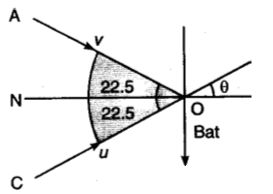
The ball struck by the bat is deflected back such that the total angle is $45^{\circ}$.
Image
Now, initial momentum of ball $= mu \cos \theta$
$
\begin{aligned}
& =\frac{0.15 \times 54 \times 1000 \times \cos 22.5}{3600} \\
& =0.15 \times 15 \times 0.9239 \text { along ON }
\end{aligned}
$
Final momentum of ball $=$ mucos $\theta$ along ON
Impulse $=$ change in momentum
$=\operatorname{mucos} \theta-(-m u c o s \theta)$
$=2 mucos \theta$
$=2 \times 0.15 \times 15 \times 0.9239$
i.e., Impulse $=4.16 kg ms ^{-1}$

Need a full question paper?

Generate a complete, print-ready paper with questions like this in minutes — across 16+ boards, with answer keys.

Start Generating Free

Similar questions

Give examples of a one-dimensional motion where: The particle moving along positive x-direction comes to rest periodically and moves forward.
Write the expressions for $C_v$ and $C_p$ of a gas in terms of gas constant R and constant $\gamma,$ where $\gamma=\frac{\text{C}_\text{P}}{\text{C}_\nu}$
Suppose an attractive nuclear force acts between two protons which may be written as $\text{F}=\text{Ce}^{-\text{kr}}/\text{r}^2.$
  1. Write down the dimensional formulae and appropriate $SI$ units of $C$ and $k.$
  2. Suppose that $k = 1\ \text{fermi}^{-1}$ and that the repulsive electric force between the protons is just balanced by the attractive nuclear force when the separation is $5$ fermi. Find the value of $C.$
Give examples of a one-dimensional motion where:
The particle moving along positive x-direction comes to rest periodically and moves forward.
Compute the fractional change in volume of a glass slab, when subjected to a hydraulic pressure of $10$ atm.
Prove that as the object moves towards the ground from some height, its potential energy decreases and kinetic energy increases by the same amount.
A block of metal of mass 50 g when placed over an inclined plane at an angle of $15^{\circ}$ slides down without acceleration. If the inclination is increased by $15^{\circ}$, what would be the acceleration of the block?
Prove for an adiabatic process:
  1. $\text{TV}^{\gamma-1}=\text{constant}.$
  2. $\text{P}^{1-\gamma}\text{T}^\gamma=\text{constant.}$
A car moves with a speed of $54\ km/h$ towards a cliff. The horn of the car emits sound of frequency $400Hz$ at a speed of $3.35m/s.$
  1. Find the wavelength of the sound emitted by the horn in front of the car.
  2. Find the wavelength of the wave reflected from the cliff.
  3. What frequency does a person sitting in the car hear for the reflected sound wave?
  4. How many beats does he hear in $10$ seconds between the sound coming directly from the horn and that coming after the reflection?
Show that the area of the triangle contained between the vectors a and b is one half of the magnitude of a × b.