Question
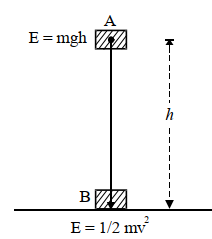
Prove that as the object moves towards the ground from some height, its potential energy decreases and kinetic energy increases by the same amount.

Need a full question paper?

Generate a complete, print-ready paper with questions like this in minutes — across 16+ boards, with answer keys.

Start Generating Free

Similar questions

Write the dimensions of the following:
  1. Gravitational potential.
  2. Variable force.
  3. Pressure gradient.
  4. Moment of inertia.
  5. Buoyant force.
  6. Angular momentum.
  7. Work done by torque.
  8. Moment of momentum.
  9. Moment of force.
  10. Pressure energy.
The acceleration experienced by a boat, after its engine is cut off, given by, $\frac{\text{dv}}{\text{dt}}=-\text{kv}^3,$ where k is a constant. If $v_0$ is the magnitude of velocity at cut off $(t = 0)$, find the magnitude of the velocity at a time t after the cut off.
The temperature and relative humidity in a room are $300K$ and $20\%$ respectively. The volume of the room is $50m^3$. The saturation vapour pressure at $300K$ is $3.3kPa$. Calculate the mass of the water vapour present in the room.
The orbital velocity v of a satellite may depend on its mass m, distance r from the centre of Earth and acceleration due to gravity g. Obtain an expression for orbital velocity.
A parallel-plate capacitor having plate area $25cm^2$ and separation 1.00mm is connected to a battery of 6.0V. Calculate the charge flown through the battery. How much work has been done by the battery during the process?
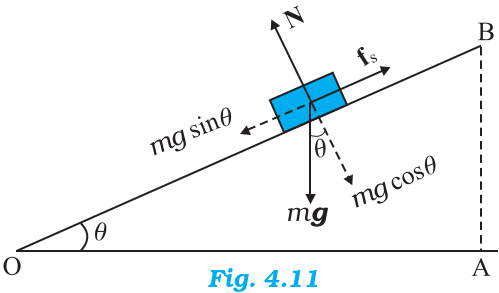
See Fig. 4.11. A mass of 4 kg rests on a horizontal plane. The plane is gradually inclined until at an angle θ = 15° with the horizontal, the mass just begins to slide. What is the coefficient of static friction between the block and the surface ?
Image
A cricket ball of mass $150g$ is moving with a velocity of $12ms^{-1}$ and is hit by a bat so that the ball is turned back with a velocity of $20ms^{-1}$. The force of the blow acts for $0.01s$. Find the average force exerted on the ball by the bat.
Does the temperature of a body depend on the frame from which it is observed?
Three objects of equal mass $M$ are located at the vertices of an equilateral triangle of side $a$. At what speed should the three bodies be rotated on a circle so that the triangle moves on the circumference of the circular chamber and the side of the triangle remains unchanged.
A horizontal force of $500N$ pulls two masses $10kg$ and $20kg$ (lying on a frictionless table) connected by a light string as shown. What is the tension in the string? Does the answer depend on which mass the pull is applied?