MCQ
A batsman deflects a ball by an angle of $45^o$ without changing its initial speed which is equal to $54\; km/h$. What is the impulse imparted to the ball in $kg\;m/s$? (Mass of the ball is $0.15 \;kg.)$
  • A
    $6.8$
  • B
    $8.32$
  • C
    $2.8$
  • $4.16$

Answer

Correct option: D.
$4.16$
d
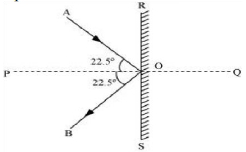
The given situation can be represented as shown in the following figure

Where, $AO =$ Incident path of the ball

$OB =$ Path followed by the ball after deflection

$\angle AOB =$ Angle between the incident and deflected paths of the ball $=45^{\circ}$

$\angle AOP =\angle BOP =22.5^{\circ}=\theta$

Initial and final velocities of the ball $=v$

Horizontal component of the initial velocity $=v \cos \theta$ along $RO$

Vertical component of the initial velocity $=v \sin \theta$ along $PO$

Horizontal component of the final velocity $=v \cos \theta$ along $OS$

Vertical component of the final velocity $=v \sin \theta$ along $OP$

The horizontal components of velocities suffer no change. The vertical components of velocities are in the opposite directions.

$\therefore$ Impulse imparted to the ball $=$ Change in the linear momentum of the ball $=m v \cos \theta-(-m v \cos \theta)$ $=2 m v \cos \theta$

Mass of the ball, $m=0.15\, kg$

Velocity of the ball, $v=54 \,km / h =15 \,m / s$

$\therefore \text { Impulse }=2 \times 0.15 \times 15 \cos 22.5^{\circ}=4.16\, kg\, m / s$
Need a full question paper?

Generate a complete, print-ready paper with questions like this in minutes — across 16+ boards, with answer keys.
Start Generating Free

Similar questions

......... $m/s^2$ is magnitude of acceleration of a block moving with speed $10\,m/s$ on a rough surface if coefficient of friction is $0.2$.
Two particles undergo $SHM$ along parallel lines with the same time period $(T)$ and equal amplitudes. At a particular instant, one particle is at its extreme position while the other is at its mean position. They move in the same direction. They will cross each other after a further time
A screw gauge of pitch $0.5\,mm$ is used to measure the diameter of uniform wire of length $6.8\,cm$, the main scale reading is $1.5\,mm$ and circular scale reading is $7$. The calculated curved surface area of wire to appropriate significant figures is $......cm^2$ . [Screw gauge has $50$ divisions on the circular scale]
Newtons law are not valid in:
Stationary waves
The position of a particle is given by : $\overrightarrow {r\,}  = (\hat i + 2\hat j - \hat k)$ and momentum $\overrightarrow P  = (3\hat i + 4\hat j - 2\hat k)$. The angular momentum is perpendicular to        
Consider a binary star system of star $A$ and star $B$ with masses $m_{A}$ and $m_{B}$ revolving in a circular orbit of radii $r_{A}$ and $r_{B}$, respectively. If $T_{A}$ and $T_{B}$ are the time period of star $A$ and star $B$, respectively, then -
If two rods of length $L$ and $2L$ having coefficients of linear expansion $\alpha$ and $2\alpha$ respectively are connected so that total length becomes $3L$, the average coefficient of linear expansion of the composition rod equals:
A particle is performing simple harmonic motion
$(i)$ its velocity-displacement graph is parabolic in nature
$(ii)$ its velocity-time graph is sinusoidal in nature
$(iii)$ its velocity-acceleration graph is elliptical in nature
Correct answer is
A heat engine has an efficiency $\eta.$ Temperatures of source and sink are each decreased by $100K.$ The efficiency of the engine: