A battery does $200 \,J$ of work in charging a capacitor. The energy stored in the capacitor is ......... $J$
Medium


Download our appand get started for free
Experience the future of education. Simply download our apps or reach out to us for more information. Let's shape the future of learning together!No signup needed.*
Similar Questions
- 1Electric potential at any point is $V = -5x + 3y + \sqrt {15} z$, then the magnitude of the electric field isView Solution
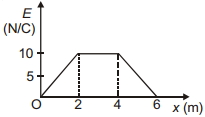
- 2Figure shows the variation of electric field intensity $E$ versus distance $x$. What is the potential difference between the points at $x=2 \,m$ and at $x=6 \,m$ from $O$ is ............. $V$View Solution
- 3A parallel plate capacitor has circular plates of $10\, cm$ radius separated by an air-gap of $1\, mm$. It is charged by connecting the plates to a $100\, volt$ battery. Then the change in energy stored in the capacitor when the plates are moved to a distance of $1\, cm$ and the plates are maintained in connection with the battery, isView Solution
- 4Two conducting spheres of radii $5\, cm$ and $10\, cm$ are given a charge of $15\,\mu C$ each. After the two spheres are joined by a conducting wire, the charge on the smaller sphere is.......$\mu C$View Solution
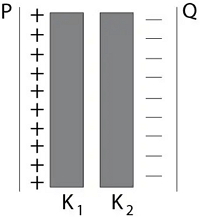
- 5Two thin dielectric slabs of dielectric constants $K_1$ and $K_2$ $(K_1 < K_2)$ are inserted between plates of a parallel plate capacitor, as shown in the figure. The variation of electric field $E$ between the plates with distance $d$ as measured from plate $P$ is correctly shown byView Solution
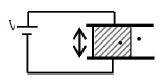
- 6A parallel plate capacitor, partially filled with a dielectric slab of dielectric constant $K$ , is connected with a cell of emf $V\ volt$ , as shown in the figure. Separation between the plates is $D$ . ThenView Solution
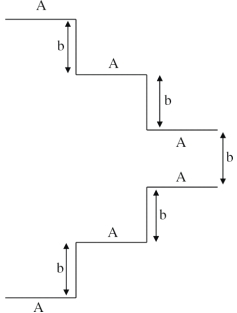
- 7A paralle plate capacitor is made up of stair like structure with a palte area $A$ of each stair and that is connected with a wire of length $b$, as shown in the figure. The capacitance of the arrangement is $\frac{ x }{15} \frac{\varepsilon_{0} A }{ b }$. The value of $x$ is ............View Solution
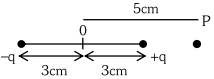
- 8An electric dipole is placed as shown in the figure.The electric potential (in $10^2\,V$ ) at point $P$ due to the dipole is $\left(\epsilon_0=\right.$ permittivity of free space and $\left.\frac{1}{4 \pi \epsilon_0}=K\right)$ :View Solution
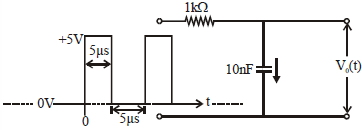
- 9For the given input voltage waveform $V_{\text {in }}( t )$, the output voltage waveform $V _{ D }( t ),$ across the capacitor is correctly depicted by:View Solution
- 10Two point charges $100\,\mu \,C$ and $5\,\mu \,C$ are placed at points $A$ and $B$ respectively with $AB = 40\,cm$. The work done by external force in displacing the charge $5\,\mu \,C$ from $B$ to $C$, where $BC = 30\,cm$, angle $ABC = \frac{\pi }{2}$ and $\frac{1}{{4\pi {\varepsilon _0}}} = 9 \times {10^9}\,N{m^2}/{C^2}$.........$J$View Solution