Two conducting spheres of radii $5\, cm$ and $10\, cm$ are given a charge of $15\,\mu C$ each. After the two spheres are joined by a conducting wire, the charge on the smaller sphere is.......$\mu C$
Medium


Download our appand get started for free
Experience the future of education. Simply download our apps or reach out to us for more information. Let's shape the future of learning together!No signup needed.*
Similar Questions
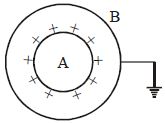
- 1$A$ and $B$ are two concentric spheres. If $A$ is given a charge $Q$ while $B$ is earthed as shownView Solution
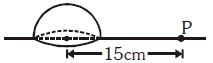
- 2Figure shows a solid hemisphere with a charge of $5\ nC$ distributed uniformly through its volume. The hemisphere lies on a plane and point $P$ is located on this plane, along a radial line from the centre of curvature at distance $15\ cm$. The electric potential at point $P$ due to the hemisphere, is .....$V$View Solution
- 3Three point charges $q, q$ and $-2 q$ are placed at the corners of an equilateral triangle of side '$L$'. Calculate work done by extemal force in moving all the charges far apart without accelerationView Solution
- 4Two capacitors, each having capacitance $40\,\mu F$ are connected in series. The space between one of the capacitors is filled with dielectric material of dielectric constant $K$ such that the equivalence capacitance of the system became $24\,\mu F$. The value of $K$ will be.View Solution
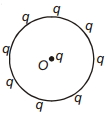
- 5A point charge $q$ is surrounded by eight identical charges at distance $r$ as shown in figure. How much work is done by the forces of electrostatic repulsion when the point charge at the centre is removed to infinity?View Solution
- 6View SolutionAssertion : Two equipotential surfaces cannot cut each other.
Reason : Two equipotential surfaces are parallel to each other.
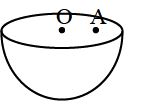
- 7Charge is uniformly distributed on the surface of a hollow hemisphere. Let $O$ and $A$ be two points on the base of the hemisphere and $V_0$ and $V_A$ be the electric potentials at $O$ and $A$ respectively. Then,View Solution
- 8Two point charges $-q$ and $+q$ are located at points $(0, 0, -a)$ and $(0, 0, a),$ respectively. The potential at a point $(0, 0, z)$ where $z > a$ isView Solution
- 9A parallel plate capacitor is made by stacking $n$ equally spaced plates connected alternately. If the capacitance between any two plates is $C$ then the resultant capacitance isView Solution
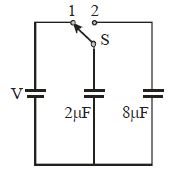
- 10A $2\,\mu F$ Capacitor is charged as shown in the figure. The percentage of its store energy dissipated after the switch $S$ is turned to position $2$, is.....$\%$View Solution