A black body at a temperature of $1640 K$ has the wavelength corresponding to maximum emission equal to $1.75$ $\mu $. Assuming the moon to be a perfectly black body, the temperature of the moon, if the wavelength corresponding to maximum emission is $ 14.35$ $\mu $ is ...... $K$
Easy
Download our app for free and get started
(c) $\frac{{{T_2}}}{{{T_1}}} = \frac{{{\lambda _{{m_1}}}}}{{{\lambda _{{m_2}}}}} = \frac{{1.75}}{{14.35}} \Rightarrow {T_2} = \frac{{1.75}}{{14.35}} \times 1640 = 200\;K$

Download our appand get started for free
Experience the future of education. Simply download our apps or reach out to us for more information. Let's shape the future of learning together!No signup needed.*
Similar Questions
- 1A body cools in a surrounding which is at a constant temperature of ${\theta _0}$. Assume that it obeys Newton's law of cooling. Its temperature $\theta $ is plotted against time $t$ . Tangents are drawn to the curve at the points $P(\theta = {\theta _1})$ and $Q(\theta = {\theta _2})$. These tangents meet the time axis at angles of ${\varphi _2}$and ${\varphi _1}$, as shownView Solution

- 2If the temperature of a black body be increased from ${27^o}C$ to ${327^o}C$ the radiation emitted increases by a fraction ofView Solution
- 3On a clear sunny day, an object at temperature $T$ is placed on the top of a high mountain. An identical object at the same temperature is placed at the foot of mountain. If both the objects are exposed to sun-rays for two hours in an identical manner, the object at the top of the mountain will register a temperatureView Solution
- 4Two identical beakers $A$ and $B$ contain equal volumes of two different liquids at $60\,^oC$ each and left to cool down. Liquid in $A$ has density of $8 \times10^2\, kg / m^3$ and specific heat of $2000\, Jkg^{-1}\,K^{-1}$ while liquid in $B$ has density of $10^3\,kgm^{-3}$ and specific heat of $4000\,JKg^{-1}\,K^{-1}$ . Which of the following best describes their temperature versus time graph schematically? (assume the emissivity of both the beakers to be the same)View Solution
- 5Radiation from a black body at the thermodynamic temperature $T_1$ is measured by a small detector at distance $d_1$ from it. When the temperature is increased to $T_2$ and the distance to $d_2$ , the power received by the detector is unchanged . What is the ratio $d_2/d_1$ ?View Solution
- 6Two thermometers $A$ and $B$ are exposed in sun light. The valve of $A$ is painted black, But that of $B$ is not painted. The correct statement regarding this case isView Solution
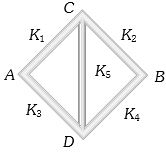
- 7Five rods of same dimensions are arranged as shown in the figure. They have thermal conductivities $K1, K2, K3, K4$ and $K5$ . When points $A$ and $B$ are maintained at different temperatures, no heat flows through the central rod ifView Solution
- 8Two metal spheres have radil $r$ and $2 r$ and they emit thermal radiation with maximum intensities at wavelengths $\lambda$ and $2 \lambda$ respectively. The respective ratio of the radiant energy emitted by them per second will be .........View Solution
- 9A hot black body emits the energy at the rate of $16\ J\ m^{-2}\ s^{-1}$ and its most intense radiation corresponds to $20,000\ Å$ . When the temperature of this body is further increased and its most intense radiation corresponds to $10,000\ Å$ , then the energy radiated in $Jm^{-2}\ s^{-1}$ will beView Solution
- 10Three rods $AB, BC$ and $AC$ having thermal resistances of $10\, units, \,10 \,units$ and $20 \,units,$ respectively, are connected as shown in the figure. Ends $A$ and $C$ are maintained at constant temperatures of $100^o C$ and $0^o C,$ respectively. The rate at which the heat is crossing junction $B$ is ........ $ \mathrm{units}$View Solution