Question
The dimensions of thermal resistance are

Answer

(a)Thermal resistance
$ = \frac{l}{{KA}} = \left[ {\frac{L}{{ML{T^{ - 3}}{K^{ - 1}} \times {L^2}}}} \right] = [{M^{ - 1}}{L^{ - 2}}{T^3}K]$

Need a full question paper?

Generate a complete, print-ready paper with questions like this in minutes — across 16+ boards, with answer keys.
Start Generating Free

Similar questions

Two balls $A$ and $B$ are thrown with same velocity $u$ from the top of a tower. Ball $A$ is thrown vertically upwards and the ball $B$ is thrown vertically downwards. If $t_A = 6\  s$ and $t_B = 2\ s$, then the height of the tower is ......... $m$
Which of the following statements is false?
A diatomic gas follows equation $PV^m =$ constant, during a process. What should be the value of $m$ such that its molar heat capacity during process $= R$
In a Young's double slit experiment, the distance between the two identical slits is $6.1$ times larger than the slit width. Then the number of intensity maxima observed with in the central maximum of the single slit diffraction pattern is
Four particles each of mass $m$ are placed at the vertices of a square of side $l.$ The potential energy of the system is
The velocity of the photoelectron emitted in the photoelectric effect depends only on:
The ratio of maximum acceleration to maximum velocity in a simple harmonic motion is $10\,s^{-1}$.  At, $t = 0$ the displacement is $5\, m$. What is the maximum acceleration ? The initial phase is $\frac{\pi }{4}$
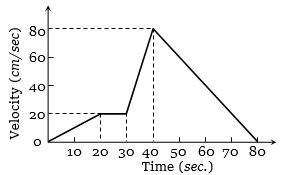
The $v - t$ graph of a moving object is given in figure. The maximum acceleration is...........$\mathrm{cm/sec}^{2}$
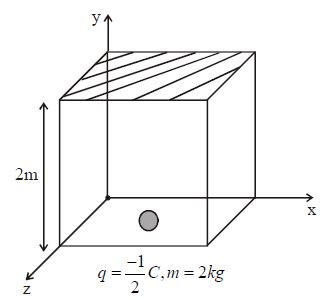
Consider a gravity free container as shown. System is initially at rest and electric potential in the regon is $V = (y^3+2)\  J/C$. A ball of charge $q$ and mass $m$ is released from rest from base starts to move up due to electric field and collides with the shaded face as shown.If its speed just after collision is $1.5\  m/s$ and time for which ball is in contact with shaded face is $0.1\ sec$, find external force required to hold the container fixed in its position during collision assuming ball exerts constant force on wall during entire span of collision.......$N$
When a potential difference $V$ is applied across a wire of resistance $R$, it dissipates energy at a rate $W$. If the wire is cut into two halves and these halves are connected mutually parallel across the same supply, the same supply, the energy dissipation rate will become: