The rate of radiation of energy from a hot object is maximum, if its surface is ...........
Easy


Download our appand get started for free
Experience the future of education. Simply download our apps or reach out to us for more information. Let's shape the future of learning together!No signup needed.*
Similar Questions
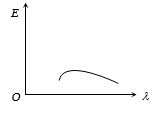
- 1The energy distribution $E$ with the wavelength $(\lambda )$ for the black body radiation at temperature $T\;Kelvin$is shown in the figure. As the temperature is increased the maxima willView Solution
- 2Consider two rods of same length and different specific heats $\left(S_{1}, S_{2}\right)$, conductivities $\left(K_{1}, K_{2}\right)$ and area of cross-sections $\left(A_{1}, A_{2}\right)$ and both having temperatures $T_{1}$ and $T_{2}$ at their ends. If rate of loss of heat due to conduction is equal, thenView Solution
- 3Two metal spheres have radil $r$ and $2 r$ and they emit thermal radiation with maximum intensities at wavelengths $\lambda$ and $2 \lambda$ respectively. The respective ratio of the radiant energy emitted by them per second will be .........View Solution
- 4An ice cube of dimensions $60\,cm \times 50\,cm \times 20\,cm$ is placed in an insulation box of wall thickness $1\,cm$. The box keeping the ice cube at $0^{\circ}\,C$ of temperature is brought to a room of temperature $40^{\circ}\,C$. The rate of melting of ice is approximately. (Latent heat of fusion of ice is $3.4 \times 10^{5}\,J\,kg ^{-1}$ and thermal conducting of insulation wall is $0.05\,Wm ^{-10} C ^{-1}$ )View Solution
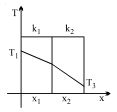
- 5The temperature drop through each layer of a two layer furnace wall is shown in figure. Assume that the external temperature $T_1$ and $T_3$ are maintained constant and $T_1 > T_3$. If the thickness of the layers $x_1$ and $x_2$ are the same, which of the following statements are correct.View Solution
- 6Ice starts forming in lake with water at ${0^o}C$ and when the atmospheric temperature is $ - {10^o}C$. If the time taken for $1 \;cm$ of ice be $7$ hours, then the time taken for the thickness of ice to change from $1\; cm$ to $2\; cm$ isView Solution
- 7View SolutionA piece of iron is heated in a flame. It first becomes dull red then becomes reddish yellow and finally turns to white hot. The correct explanation for the above observation is possible by using
- 8The absolute temperatures of two black bodies are $2000 K$ and $3000 K$ respectively. The ratio of wavelengths corresponding to maximum emission of radiation by them will beView Solution
- 9In a room where the temperature is ${30^o}C$, a body cools from ${61^o}C$ to ${59^o}C$ in $4$ minutes. The time (in min.) taken by the body to cool from ${51^0}C$ to ${49^0}C$ will be ....... $\min$View Solution
- 10A $5cm$ thick ice block is there on the surface of water in a lake. The temperature of air is $-10°C$ ; how much time it will take to double the thickness of the block ...... hour ($L = 80 cal/g, Kicc = 0.004 Erg/s-k, dice = 0.92 g cm^{-3}$)View Solution