A black coloured solid sphere of radius $R$ and mass $M$ is inside a cavity with vacuum inside. The walls of the cavity are maintained at temperature $T_0$. The initial temperature of the sphere is $3T_0$. If the specific heat of the material of the sphere varies as $\alpha T^3$ per unit mass with the temperature $T$ of the sphere, where $\alpha $ is a constant, then the time taken for the sphere to cool down to temperature $2T_0$ will be ( $\sigma $ is Stefan Boltzmann constant)
JEE MAIN 2014, Diffcult
Download our app for free and get started
In the given problem, fall in temperature of sphere,
$dT = \left( {3{T_0} - 2{T_0}} \right) = {T_0}$
Tmperature of surrounding, ${T_{surr}} = {T_0}$
Initial temperature of sphere, ${T_{initial}} = 3{T_0}$
Specific heat of the material of the sphere varies as,
$c = \alpha {T^3}\,per\,unit\,mass\,\left( {\alpha = a\,constant} \right)$
Applying formula,
$\frac{{dT}}{{dt}} = \frac{{\sigma A}}{{McJ}}\left( {{T^4} - T_{surr}^4} \right)$
$ \Rightarrow \frac{{{T_0}}}{{dt}} = \frac{{\sigma 4\pi {R^2}}}{{M\alpha {{\left( {3{T_0}} \right)}^3}\,J}}\left[ {{{\left( {3{T_0}} \right)}^4} - {{\left( {{T_0}} \right)}^4}} \right]$
$ \Rightarrow dt = \frac{{M\alpha 27T_0^4J}}{{\alpha 4\pi {R^2} \times 80T_0^4}}$
Solving we get,
Time taken for the sphere to cool down temperature $2{T_{{0^,}}}$
$t = \frac{{M\alpha }}{{16\pi {R^2}\sigma }}In\left( {\frac{{16}}{3}} \right)$

Download our appand get started for free
Experience the future of education. Simply download our apps or reach out to us for more information. Let's shape the future of learning together!No signup needed.*
Similar Questions
- 1The power radiated by a black body is $P$ and it radiates maximum energy at wavelength,$\lambda_0.$ If the temperature of the black body is now changed so that it radiates maximum energy at wavelength $\frac{3}{4}\lambda_0$, the power radiated by it becomes $nP$. The value of $n$ isView Solution
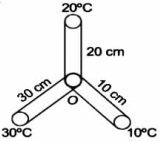
- 2Three rods of same material, same area of crosssection but different lengths $10 \,cm , 20 \,cm$ and $30 \,cm$ are connected at a point as shown. What is temperature of junction $O$ is ......... $^{\circ} C$View Solution
- 3rod of $40\, cm$ in length and temperature difference of ${80^o}C$ at its two ends. $A$ nother rod $B$ of length $60\, cm$ and of temperature difference ${90^o}C$, having the same area of cross-section. If the rate of flow of heat is the same, then the ratio of their thermal conductivities will beView Solution
- 4In a steady state of thermal conduction, temperature of the ends $A$ and $B$ of a $20\, cm$ long rod are ${100^o}C$ and ${0^o}C$ respectively. What will be the temperature of the rod at a point at a distance of $6$ cm from the end $A$ of the rod....... $^oC$View Solution
- 5View SolutionThe rates of cooling of two different liquids put in exactly similar calorimeters and kept in identical surroundings are the same if
- 6Three stars $A, B, C$ have surface temperatures $T _{A} ,T _{B}, T _{C}$ respectively. Star $A$ appears bluish, star $B$ appears reddish and star $C$ yellowish. Hence,View Solution
- 7A sphere of ice at $0^o C$ having initial radius $R$ is placed in an environment having ambient temperature $> 0^o C$. The ice melts uniformly, such that shape remains spherical. After a time $‘t’$ the radius of the sphere has reduced to$r$. Assuming the rate of heat absorption is proportional to the surface area of the sphere at any moment, which graph best depicts $r (t)$.View Solution
- 8If the temperature of a hot body is increased by $50\%$ then the increase in the quantity of emitted heat radiation will be ..... $\%$View Solution
- 9View SolutionWhich factor does not affect convection?
- 10A hot body, obeying Newton's law of cooling is cooling down from its peak value $80\,^oC$ to an ambient temperature of $30\,^oC$ . It takes $5\, minutes$ in cooling down from $80\,^oC$ to $40\,^oC$. ........ $\min.$ will it take to cool down from $62\,^oC$ to $32\,^oC$ ? (Given $ln\, 2\, = 0.693, ln\, 5\, = 1.609$)View Solution