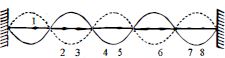
A stretched string is vibrating in its $5^{th}$ harmonic as shown. Consider a particle $1(figure)$. At an instant this particle is at mean positions and is moving towards its negative extreme. Which of the following set of particles, are in same phase with particle $1$
Easy


Download our appand get started for free
Experience the future of education. Simply download our apps or reach out to us for more information. Let's shape the future of learning together!No signup needed.*
Similar Questions
- 1Two speakers connected to the same source of fixed frequency are placed $2.0 m $ apart in a box. A sensitive microphone placed at a distance of $4.0m$ from their midpoint along the perpendicular bisector shows maximum response. The box is slowly rotated until the speakers are in line with the microphone. The distance between the midpoint of the speakers and the microphone remains unchanged. Exactly five maximum responses are observed in the microphone in doing this. The wavelength of the sound wave is .... $m$View Solution
- 2An open pipe of length $33\, cm$ resonates to a frequency of $1000\,Hz$. The mode of vibration is: (velocity of sound $= 330\, m/s$)View Solution
- 3The string of a violin emits a note of $205 \,Hz$ at its correct tension. The string is tightened slightly and then it produces six beats in two seconds with a tuning fork of frequency $205 Hz$. The frequency of the note emitted by the taut string is .......... $Hz$View Solution
- 4A string wave equation is given $y=0.002 \sin (300 t-15 x)$ and mass density is $\mu=\frac{0.1\, kg }{m}$. Then find the tension in the string, (in $N$)View Solution
- 5A student determines the velocity of sound with the help of a closed organ pipe. If the observed length for fundamental frequency is $24.7 m$, the length for third harmonic will be .... $cm$View Solution
- 6The displacement y of a particle in a medium can be expressed as: $y = {10^{ - 6}}\sin (100t + 20x + \pi /4)m,$ where $t$ is in second and $x$ in meter. The speed of wave is ... $m/s$View Solution
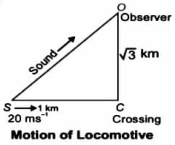
- 7A locomotive approaching a crossing at a speed of $20 \,ms ^{-1}$ sounds a whistle of frequency $640 \,Hz$ when $1 \,km$ from the crossing. There is no wind and the speed of sound in air is $330 \,ms ^{-1}$. What frequency is heard by an observer $\sqrt{3} \,km$ on the straight road from the crossing at right angle ......... $Hz$View Solution
- 8A sounding body of negligible dimension emitting a frequency of $150\,\, Hz$ is dropped from a height. During its fall under gravity it passes near a balloon moving up with a constant velocity of $2m/s$ one second after it started to fall.The difference in the frequency observed by the man in balloon just before and just after crossing the body will be : (Given that -velocity of sound $= 300m/s; g = 10m/s^2$)View Solution
- 9If the equation of transverse wave is $y = 5\sin 2\pi \left[ {\frac{t}{{0.04}} - \frac{x}{{40}}} \right]$, where distance is in $ cm$ and time in second, then the wavelength of the wave is .... $cm$View Solution
- 10A string of length $0.4\, m$ and mass ${10^{ - 2}}\,kg$ is tightly clamped at its ends. The tension in the string is $1.6\, N.$ Identical wave pulses are produced at one end at equal intervals of time $\Delta t$. The minimum value of $\Delta t$ which allows constructive interference between successive pulses is .... $s$View Solution