MCQ
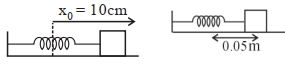
A block is fastened to a horizontal spring. The block is pulled to a distance $x =10\,cm$ from its equilibrium position (at $x =0$ ) on a frictionless surface from rest. The energy of the block at $x =5$ $cm$ is $0.25\,J$. The spring constant of the spring is $.........Nm ^{-1}$
  • A
    $65$
  • B
    $66$
  • C
    $69$
  • $50$

Answer

Correct option: D.
$50$
d
$U _{ i } =\frac{1}{2} kx _0^2$

$K _{ i } =0$

$U _{ f }=\frac{1}{2} k \left(\frac{ x _0}{2}\right)^2$

$K _{ f }=0.25\,J$

$\frac{1}{2} kx _0^2+0=\frac{1}{2} k \frac{ x _0^2}{4}+0.25$

$\frac{1}{2} k x _0^2 \frac{3}{4}=\frac{1}{4}$

$\frac{1}{2} k \frac{3}{100}=1 \Rightarrow k =\frac{200}{3}\,N / m$

$=67\,N / m$

Need a full question paper?

Generate a complete, print-ready paper with questions like this in minutes — across 16+ boards, with answer keys.

Start Generating Free

Similar questions

$50\, gm$ of copper is heated to increase its temperature by $10^oC$. If the same quantity of heat is given to $10\; gm$ of water, the rise in its temperature is ........ $^oC$ (Specific heat of copper $= 420 \;Joule-kg^{-1} {°C^{-1}}$)
Gas obey $P^2V =$ constant. The initial temperature and volume are $T_0$ and $V_0$. If gas expands to volume $2V_0$, the final temp is
An ideal gas is enclosed in a cylinder at pressure of $2\,atm$ and temperature, $300\,K.$ The mean time between two successive collisions is $6 \times 10^{-8}\, s.$ If the pressure is doubled and temperature is increased to $500\,K,$ the mean time between two successive collisions will be close to
Conservation laws are such that:
A body of weight 72 N moves from the surface of earth at a height half of the radius of earth, then gravitational force exerted on it will be:
Two resistances are given as $R _1=(10 \pm 0.5)\,\Omega$ and $R_2=(15 \pm 0.5)\, \Omega$. The percentage error in the measurement of equivalent resistance when they are connected in parallel is
A rod of length $l$ and radius $r$ is joined to a rod of length $l/2$ and radius $r/2$ of same material. The free end of small rod is fixed to a rigid base and the free end of larger rod is given a twist of $\theta°$, the twist angle at the joint will be
Put a uniform meter scale horizontally on your extended index fingers with the left one at $0.00 cm$ and the right one at $90.00 cm$. When you attempt to move both the fingers slowly towards the center, initially only the left finger slips with respect to the scale and the right finger does not. After some distance, the left finger stops and the right one starts slipping. Then the right finger stops at a distance $x_R$ from the center ( $50.00 cm$ ) of the scale and the left one starts slipping again. This happens because of the difference in the frictional forces on the two fingers. If the coefficients of static and dynamic friction between the fingers and the scale are $0.40$ and $0.32$ , respectively, the value of $x_R($ in $cm )$ is. . . . . . . 
When an object is in equilibrium state, then
The $SI$ unit of universal gas constant is