Question
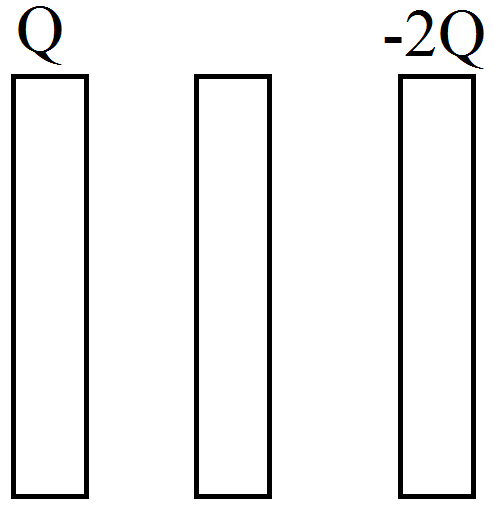
Three identical metal plates with large surface areas are kept parallel to each other as shown in figure. The leftmost plate is given a charge Q, the rightmost a charge -2Q and the middle one remains neutral. Find the charge appearing on the outer surface of the rightmost plate.
Answer


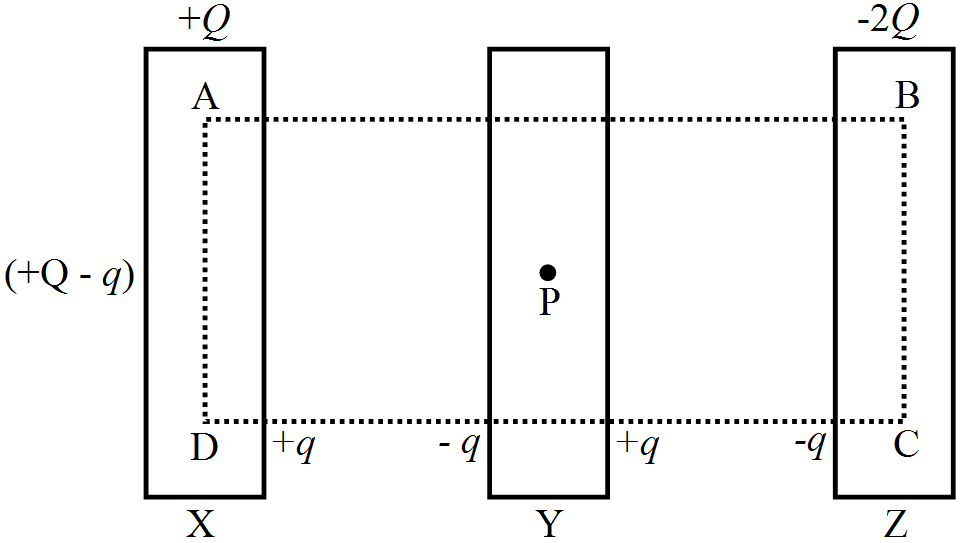
Consider the Gaussian surface as shown in the figure.
Let the charge on the outer surface of the left-most plate be q. Thus, the charges on the plates are distributed as shown in the diagram.
The net field at point P due to all the induced charges must be zero, as it is lying inside the metal surface.
Let the surface area of the plates be A.
Electric field at point P due to the charges on plate X:
Due to charge (+Q - q) is $\frac{\text{Q}-\text{q}}{2\text{A}\in_0}$ in the right direction
Due to charge (+q) is $\frac{\text{q}}{2\text{A}\in_0}$ in the right direction
Electric field at point P due to charges on plate Y:
Due to charge (-q) is $\frac{\text{q}}{2\text{A}\in_0}$ in the right direction
Due to charge (+q) is $\frac{\text{q}}{2\text{A}\in_0}$ in the left direction
Electric field at point P due to charges on plate Z:
Due to charge (-q) is $\frac{\text{q}}{2\text{A}\in_0}$ in the right direction
Due to charge (-2Q + q) is $\frac{\text{2Q}-\text{q}}{2\text{A}\in_0}$ in the right direction
The net electric field at point P:
$\frac{\text{Q}-\text{q}}{2\text{a}\in_0}+\frac{\text{q}}{2\text{A}\in_0}-\frac{\text{q}}{2\text{A}\in_0}-\frac{\text{q}}{2\text{A}\in_0}+\frac{\text{q}}{2\text{A}\in_0}+\frac{\text{2Q}-\text{q}}{2\text{A}\in_0}=0$
$\frac{\text{Q}-\text{q}}{2\text{A}\in_0}+\frac{\text{2Q}-\text{q}}{2\text{A}\in_0}=0$
$\text{Q}-\text{q}+\text{2Q}-\text{q}=0$
$\text{3Q}-2\text{q}=0$
$\text{q}=\frac{\text{3Q}}{2}$
Thus, the charge on the outer plate of the right-most plate
$-2\text{Q}+\text{q}=-2\text{Q}+\frac{3\text{Q}}{2}=-\frac{\text{Q}}{2}$

Need a full question paper?

Generate a complete, print-ready paper with questions like this in minutes — across 16+ boards, with answer keys.

Start Generating Free

Similar questions

A hot gas emits radiation of wavelengths 46.0nm, 82.8nm and 103.5nm only. Assume that the atoms have only two excited states and the difference between consecutive energy levels decreases as energy is increased. Taking the energy of the highest energy state to be zero, find the energies of the ground state and the first excited state.
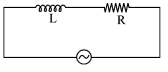
In the given figure, voltage across the ends of inductor ( L ) and resistor ( R ) is 120 V and 90 V respectively. The root mean square value of the current is 3 A. Calculate :
(i) impedance of the circuit and (ii) phase difference between voltage and current.
Image
  1. Define mutual inductance and write its S.I. unit.
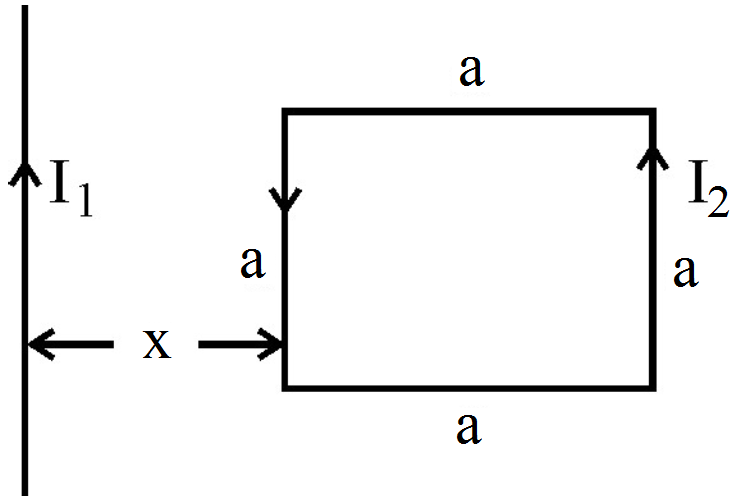
  2. A square loop of side ‘a’ carrying a current $I_2$ is kept at distance x from an infinitely long straight wire carrying a current $I_1$ as shown in the figure. Obtain the expression for the resultant force acting on the loop.
One end of a cylindrical glass rod $(\mu=1.5)$ of radius 1.0cm is rounded in the shape of a hemisphere. The rod is immersed in water $\Big(\mu=\frac{4}{3}\Big)$ and an object is placed in the water along the axis of the rod at a distance of 8.0cm from the rounded edge. Locate the image of the object.
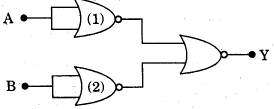
The inputs A and B are inverted by using two NOT gates and their outputs are fed to the NOR gate as shown below.

Analyse the action of the gates (1) and (2) and identify the logic gate of the complete circuit so obtained. Give its symbol and the truth table.
The intensity of sound from a point source is $1.0 \times 10^{-6}W/m^2$ at a distance of 5.0m from the source. What will be the intensity at a distance of 25m from the source?
Define the term wavefront. State Huygen's principle. Consider a plane wavefront incident on a thin convex lens. Draw a proper diagram to show how the incident wavefront traverses through the lens and after refraction focusses on the focal point of the lens, giving the shape of the emergent wavefront.
  1. In a typical nuclear reaction, e.g.
$^{2}_{1}\text{H} +^{2}_{1}\text{H}\rightarrow^{3}_{2}\text{He} + \text{n} + 3.27\text{MeV}$

although number of nucleons is conserved, yet energy is released. How? Explain.
  1. Show that nuclear density in a given nucleus is independent of mass number A.
Is Huygen’s principle valid for longitudunal sound waves?
The kinetic energy K of a rotating body depends on its moment of inertia I and its angular speed $\omega.$ Assuming the relation to be $\text{K}=\text{kI}^{\text{a}}\omega^{\text{b}}$ where k is a dimensionless constant, find a and b. Moment of inertia of a sphere about its diameter is $\frac{2}{5}\text{Mr}^2.$