Question
Given a uniformly charged plane/sheet of surface charge density, $\sigma=2\times10^{17}\text{C/m}^2.$Image
  1. Find the electric field intensity at a point A, 5mm away from the sheet on the left side.
  2. Given a straight line with three points X, Y and Z placed 50cm away from the charged sheet on the right side. At which of these points, the field due to the sheet remain the same as that of point A and why?
Answer

  1. At A, $\text{E}=\frac{\sigma}{2\in_0}=\frac{2\times10^{17}\text{Cm}^{-2}}{2\times8.854\times10^{-12}\text{C}^2\text{N}^{-1}\text{m}^{-2}}$
$\text{E}=1.1\times1028 \text{N/C}$

Directed away from the sheet.
  1. Point Y, Because at 50cm, the charge sheet acts as a finite sheet and thus the magnitude remains same towards the middle region of the planar sheet.

Need a full question paper?

Generate a complete, print-ready paper with questions like this in minutes — across 16+ boards, with answer keys.

Start Generating Free

Similar questions

An object of size 3.0 cm is placed 14 cm in front of a concave lens of focal length 21 cm. Describe the image produced by the lens. What happens if the object is moved further away from the lens?
As the earth rotates about its axis, a person living in his house at the equator goes in a circular orbit of radius equal to the radius of the earth. Why does he/ she not feel weightless as a satellite passenger does?
Obtain the resonant frequency ωr of a series LCR circuit with L = 2.0H, C = 32μF and R = 10Ω. What is the Q-value of this circuit?
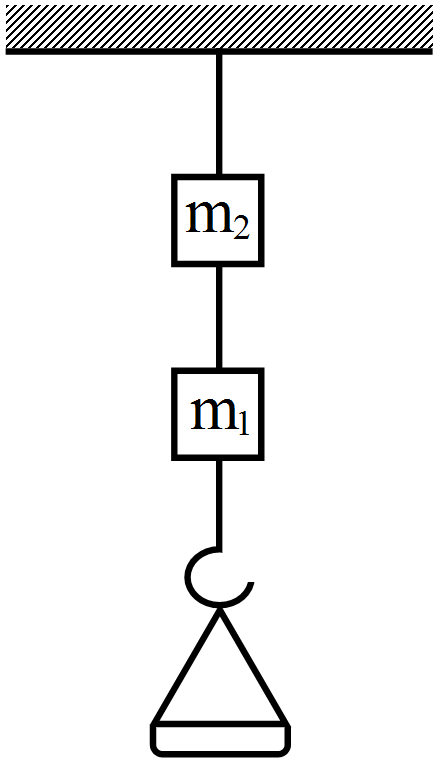
The two wires shown in are made of the,

same material which has a breaking stress of $8 \times 10^8N/m^2.$ The area of cross-section of the upper wire is $0.006cm^2$ and that of the lower wire is $0.003cm^2$. The mass $m_1 = 10kg, m_2= 20kg$ and the hanger is light:
  1. Find the maximum load that can be put on the hanger without breaking a wire. Which wire will break first if the load is increased?
  2. Repeat the above part if $m_1 = 10kg$ and $m_2 = 36kg.$
Explain how the scattering experiment can be analyzed in detail from Rutherford's nuclear model.
Write any three characteristics of nuclear force.
The conductivity of a pure semiconductor is roughly proportional to $\text{T}^\frac{3}{2}\text{e}^{\frac{-\Delta\text{E}}{2\text{kT}}}$ where $\Delta\text{E}$ is the band gap. The band gap for germanium is 0.74eV at 4K and 0.67eV at 300K. By what factor does the conductivity of pure germanium increase as the temperature is raised from 4K to 300K?
$a.$ Draw the energy level diagram for the line spectra representing Lyman series and Balmer series in the spectrum of hydrogen atom.
$b.$ Using the Rydberg formula for the spectrum of hydrogen atom, calculate the largest and shortest wavelengths of the emission lines of the Balmer series in the spectrum of hydrogen atom. $($ Use the value of Rydberg constant $\left.R =1.1 \times 10^7 m^{-1}\right)$
  1. Write an expression of magnetic moment associated with a current (I) carrying circular coil of radius r having N turns.
  2. Consider the above mentioned coil placed in YZ plane with its centre at the origin. Derive expression for the value of magnetic field due to it at point (x, 0, 0).
A series LCR circuit is connected across an a.c. source of variable angular frequency $' \omega'$. Plot a graph showing variation of current ‘i’ as a function of $' \omega'$ for two resistances $R_1$ and $R2 (R_1 > R_2).$
Answer the following questions using this graph:
  1. In which case is the resonance sharper and why?
  2. In which case is the power dissipation more and why?