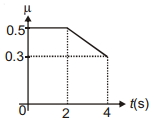
A block is projected with speed $20 \,m / s$ on a rough horizontal surface. The coefficient of friction $(\mu)$ between the surfaces varies with time $(t)$ as shown in figure. The speed of body at the end of $4$ second will be ............ $m / s$ ( $g=$ $10 \,m / s ^2$ )
Difficult
Download our app for free and get started
(a)
Retardation
$\frac{d v}{d t}=-\mu g$
$\int d v=-\int \mu g d t$
$\Delta v=-g \int \mu d t$
$\int \mu d t$ is area under $\mu-t$ curve
$v-20=-10\left(2 \frac{1}{2}+\frac{1}{2}(2)(0.2)+(2)(0.3)\right)$
$v=20-18=2 \,m / s$

Download our appand get started for free
Experience the future of education. Simply download our apps or reach out to us for more information. Let's shape the future of learning together!No signup needed.*
Similar Questions
- 1A block is moving on an inclined plane making an angle $45^{\circ}$ with the horizontal and the coefficient of friction is $\mu$. The force required to just push it up the inclined plane is $3$ times the force required to just prevent it from sliding down. If we define $N=10 \ \mu$, then $N$ isView Solution
- 2The upper portion of an inclined plane of inclination $\alpha $ is smooth and the lower portion is rough. A particle slides down from rest from the top and just comes to rest at the foot. If the ratio of the smooth length to rough length is $m : n$ , the coefficient of friction isView Solution
- 3A car is moving on a circular path and takes a turn. If ${R_1}$ and ${R_2}$ be the reactions on the inner and outer wheels respectively, thenView Solution
- 4A particle is moving along the circle $x^2 + y^2 = a^2$ in anti clock wise direction. The $x-y$ plane is a rough horizontal stationary surface. At the point $(a\, cos\theta , a\, sin\theta )$, the unit vector in the direction of friction on the particle is:View Solution
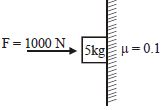
- 5For the given figure, if block remains in equilibrium position then find frictional force between block and wall ........ $N$View Solution
- 6A horizontal force of $40\,N$ is applied to a $5\, kg$ block which is at rest on the horizontal surface. If the coefficient of kinetic friction is $0.4$, then the acceleration of the block is ........ $m/s^2$ $(g = 10 \,m/s^2)$View Solution
- 7View SolutionA hockey player is moving northward and suddenly turns westward with the same speed to avoid an oopponent. The force that acts on the player is
- 8A cyclist moves in a circular track of radius $100$ m. If the coefficient of friction is $0.2$, then the maximum velocity with which the cyclist can take the turn with leaning inwards is ...... $m/s$View Solution
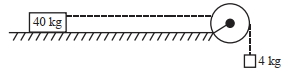
- 9A block of mass $40 \,kg$ slides over a surface, when a mass of $4 \,kg$ is suspended through an inextensible massless string passing over frictionless pulley as shown below. The coefficient of kinetic friction between the surface and block is $0.02$. The acceleration of block is ............ $ms ^{-2}$ (Given $g =10 \,ms ^{-2}$.)View Solution
- 10The maximum tension which an inextensible ring of mass $0.1\, kg/m$ can bear is $10\,N$. The maximum velocity in $m/s$ with which it can be rotated is ........ $m/s.$View Solution