A particle is moving along the circle $x^2 + y^2 = a^2$ in anti clock wise direction. The $x-y$ plane is a rough horizontal stationary surface. At the point $(a\, cos\theta , a\, sin\theta )$, the unit vector in the direction of friction on the particle is:
Difficult
Download our app for free and get started
Unit vector of point $P$ from origin is $:$
$\vec{P}=\cos \theta \hat{\imath}+\sin \theta \hat{j}$
If $\hat{\vec{F}}$ be the unit vector acting along friction. then,
$\hat{\vec{F}} \cdot \hat{\vec{P}}=0$
since friction is clockwise sense component along $\hat{i}$ direction $+ve.$
$\hat{F}=\sin \theta \hat{i}-\cos \theta \hat{j}$

Download our appand get started for free
Experience the future of education. Simply download our apps or reach out to us for more information. Let's shape the future of learning together!No signup needed.*
Similar Questions
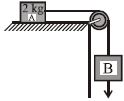
- 1The coefficient of static friction, $\mu _s$ between block $A$ of mass $2\,kg$ and the table as shown in the figure is $0.2$. What would be the maximum mass value of block $B$ so that the two blocks $B$ so that the two blocks do not move? The string and the pulley are assumed to be smooth and masseless ....... $kg$ $(g = 10\,m/s^2)$View Solution
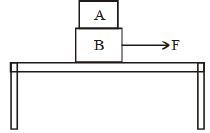
- 2Two blocks $A$ and $B$ of masses $m_A = 1\,kg$ and $m_B = 3\,kg$ are kept on the table as shown in figure. The coefficient of friction between $A$ and $B$ is $0.2$ and between $B$ and the surface of the table is also $0.2.$ The maximum force $F$ that can be applied on $B$ horizontal, so that the block $A$ does not slide over the block $B$ is ........ $N$. [Take $g = 10\,m/s^2$ ]View Solution
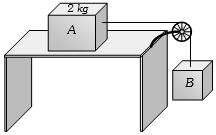
- 3The coefficient of static friction, ${\mu _s},$ between block $A$ of mass $2\, kg$ and the table as shown in the figure is $0.2$. ........ $kg$ would be the maximum mass value of block $B$ so that the two blocks do not move. The string and the pulley are assumed to be smooth and massless. $(g = 10\,m/{s^2})$View Solution
- 4A stone of mass $0.25\; kg$ tied to the end of a string is whirled round in a circle of radius $1.5 \;m$ with a speed of $40\; rev./min$ in a hortzontal plane. What is the tenston in the string? What is the maximum speed in $m/s $ with which the stone can be whirled around if the string can withstand a maximum tension of $200\; N ?$View Solution
- 5In figure, two blocks $M$ and $m$ are tied together with an inextensible and light string. The mass $M$ is placed on a rough horizontal surface with coefficient of friction $\mu$ and the mass $m$ is hanging vertically against a smooth vertical wall. The pulley is frictionless. Choose the correct statement $(s)$ related to the tension $T$ in the stringView Solution

- 6A piece of ice slides down a rough inclined plane at $\theta=45^{\circ}$ inclination in twice the time that it takes to slide down an identical but frictionless inclined plane. What is the coefficient of friction between ice and incline ?View Solution
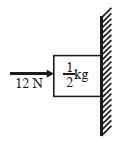
- 7A horizontal force $12 \,N$ pushes a block weighing $1/2\, kg$ against a vertical wall. The coefficient of static friction between the wall and the block is $0.5$ and the coefficient of kinetic friction is $0.35.$ Assuming that the block is not moving initially. Which one of the following choices is correct (Take $g = 10 \,m/s^2$)View Solution
- 8View SolutionThe limiting friction between two bodies in contact is independent of
- 9Starting from rest a body slides down a $45^o$ inclined plane in twice the time it takes to slide down the same distance in the absence of friction. The co-efficient of friction between the body and the inclined plane isView Solution
- 10View SolutionA homogeneous rectangular brick lies on a rough inclined plane of very small inclination. Which half part of brick exters greater contact force on plane