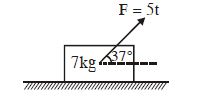
A block of $7\,kg$ is placed on a rough horizontal surface and is pulled through a variable force $F$ (in $N$ ) $= 5\,t$ , where $'t'$ is time in second, at an angle of $37^o$ with the horizontal as shown in figure. The coefficient of static friction of the block with the surface is one. If the force starts acting at $t = 0\,s$ . Find the time at which the block starts to slide ......... $\sec$ (Take $g = 10\,m/s^2$ )
Medium


Download our appand get started for free
Experience the future of education. Simply download our apps or reach out to us for more information. Let's shape the future of learning together!No signup needed.*
Similar Questions
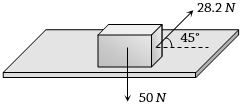
- 1A body of weight $50 \,N$ placed on a horizontal surface is just moved by a force of $28.2\, N$. The frictional force and the normal reaction areView Solution
- 2A uniform chain of length $L$ changes partly from a table which is kept in equilibrium by friction. The maximum length that can withstand without slipping is $l$, then coefficient of friction between the table and the chain isView Solution
- 3A block starts moving up an inclined plane of inclination $30^{\circ}$ with an initial velocity of $v_{0}$. It comes back to its initial position with velocity $\frac{v_{0}}{2} .$ The value of the coefficient of kinetic friction between the block and the inclined plane is close to $\frac{ I }{1000},$ The nearest integer to $I$ is......View Solution
- 4Determine the maximum acceleration in $m/s^2$ of the train in which a box lying on its floor will remain stationary, given that the co-efficient of static friction between the box and the train’s floor is $0.15.$View Solution
- 5A body of mass $2\,kg$ slides down with an acceleration of $3\,m/s^2$ on a rough inclined plane having a slope of $30^o$ . The external force required to take the same body up the plane with the same acceleration will be ........ $N$ $(g\, = 10\, m/s^2)$View Solution
- 6A block weighs $W$ is held against a vertical wall by applying a horizontal force $F$. The minimum value of $F$ needed to hold the block isView Solution
- 7View SolutionA cube is resting on an inclined plane. What must be the value of coefficient of friction between cube and plane so that cube topples before sliding
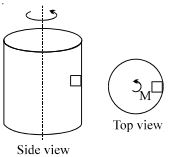
- 8A hollow vertical cylinder of radius $R$ is rotated with angular velocity $\omega$ about an axis through its center. What is the minimum coefficient of static friction necessary to keep the mass $M$ suspended on the inside of the cylinder as it rotates?View Solution
- 9A block of mass $2\,kg$ moving on a horizontal surface with speed of $4\,ms ^{-1}$ enters a rough surface ranging from $x =0.5\,m$ to $x =1.5\,m$. The retarding force in this range of rough surface is related to distance by $F =- kx$ where $k =12\,Nm ^{-1}$. The speed of the block as it just crosses the rough surface will be ........... $\,ms ^{-1}$View Solution
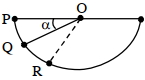
- 10A ball is released from rest from point $P$ of a smooth semi-spherical vessel as shown in figure. The ratio of the centripetal force and normal reaction on the ball at point $Q$ is $A$ while angular position of point $Q$ is $\alpha$ with respect to point $P$. Which of the following graphs represent the correct relation between $A$ and $\alpha$ when ball goes from $Q$ to $R$ ?View Solution