Determine the maximum acceleration in $m/s^2$ of the train in which a box lying on its floor will remain stationary, given that the co-efficient of static friction between the box and the train’s floor is $0.15.$
Easy


Download our appand get started for free
Experience the future of education. Simply download our apps or reach out to us for more information. Let's shape the future of learning together!No signup needed.*
Similar Questions
- 1A child weighing $25$ kg slides down a rope hanging from the branch of a tall tree. If the force of friction acting against him is $2\, N$, ........ $m/s^2$ is the acceleration of the child (Take $g = 9.8\,m/{s^2})$View Solution
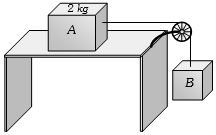
- 2The coefficient of static friction, ${\mu _s},$ between block $A$ of mass $2\, kg$ and the table as shown in the figure is $0.2$. ........ $kg$ would be the maximum mass value of block $B$ so that the two blocks do not move. The string and the pulley are assumed to be smooth and massless. $(g = 10\,m/{s^2})$View Solution
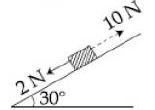
- 3A block kept on a rough inclined plane, as shown in the figure, remains at rest upto a maximum force $2\,N$ down the inclined plane. The maximum external force up the inclined plane that does not move the block is $10\,N.$ The coefficient of static friction between the block and the plane is : $[$Take $g = 10\,m/s^2 ]$View Solution
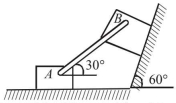
- 4In figure, two blocks are separated by a uniform strut attached to each block with frictionless pins. Block $A$ weighs $400\,N$, block $B$ weighs $300\,N$, and the strut $A B$ weigh $200\,N$. If $\mu=0.25$ under $B$, determine the minimum coefficient of friction under $A$ to prevent motion.View Solution
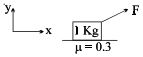
- 5A $\vec F\,\, = \,\,\hat i\, + \,4\hat j\,$ acts on block shown. The force of friction acting on the block is :View Solution
- 6Two masses $M$ and $m$ are attached to a vertical axis by weightless threads of combined length $l$. They are set in rotational motion in a horizontal plane about this axis with constant angular velocity $\omega $. If the tensions in the threads are the same during motion, the distance of $M$ from the axis isView Solution
- 7A man is standing on a rough $(\mu = 0.5)$ horizontal disc rotating with constant angular velocity of $5$ $rad/sec.$ At what distance from centre should he stand so that he does not slip on the disc?View Solution
- 8View SolutionIt is easier to roll a barrel than pull it along the road. This statement is
- 9A body of $5\, kg$ weight kept on a rough inclined plane of angle $30^o$ starts sliding with a constant velocity. Then the coefficient of friction isView Solution
- 10A cyclist riding the bicycle at a speed of $14\sqrt 3 ms^{-1}$takes a turn around a circular road of radius $20\sqrt 3 $ m without skidding. Given $g = 9.8 ms^{-2},$ what is his inclination to the vertical ....... $^o$View Solution