A block of mass $5$ kg lies on a rough horizontal table. A force of $19.6\, N$ is enough to keep the body sliding at uniform velocity. The coefficient of sliding friction is
Easy


Download our appand get started for free
Experience the future of education. Simply download our apps or reach out to us for more information. Let's shape the future of learning together!No signup needed.*
Similar Questions
- 1One end of string of length $l$ is connected to a particle of mass $'m'$ and the other end is connected to a small peg on a smooth horizontal table. If the particle moves in circle with speed $'v',$ the net force on the particle (directed towards centre) will be ($T$ represents the tension in the string)View Solution
- 2A uniform chain of length $L$ changes partly from a table which is kept in equilibrium by friction. The maximum length that can withstand without slipping is $l$, then coefficient of friction between the table and the chain isView Solution
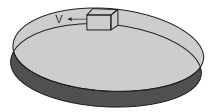
- 3A smooth circular groove has a smooth vertical wall as shown in figure. A block of mass $m$ moves against the wall with a speed $v$. Which of the following curve represents the correct relation between the normal reaction on the block by the wall $( N )$ and speed of the block $(v)$ ?View Solution
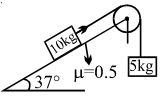
- 4The blocks are in equilibrium. The friction force acting on $10 kg$ block is :View Solution
- 5If the radius of curvature of the path of two particles of same mass are in the ratio $3:4,$ then in order to have constant centripetal force, their velocities will be in the ratio of:View Solution
- 6A body is sliding down an inclined plane having coefficient of friction $0.5$. If the normal reaction is twice that of the resultant downward force along the incline, the angle between the inclined plane and the horizontal is ....... $^o$View Solution
- 7A particle moves in a circular orbit under the action of a central attractive force inversely proportional to the distance $'r'$. The speed of the particle isView Solution
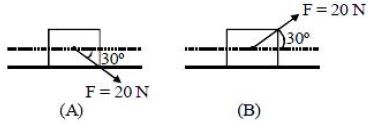
- 8A block of mass $5\, kg$ is $(i)$ pushed in case $(A)$ and $(ii)$ pulled in case $(B)$, by a force $F = 20\, N$, making an angle of $30^o$ with the horizontal, as shown in the figures. The coefficient of friction between the block and floor is $\mu = 0.2$. The difference between the accelerations of the block, in case $(B)$ and case $(A)$ will be $....... ms^{-2}$ .$(g = 10\, ms^{-2})$View Solution
- 9View SolutionThe limiting friction between two bodies in contact is independent of
- 10A block rests on a rough inclined plane making an angle of $30^o$ with the horizontal. The coefficient of static friction between the block and the plane is $0.8.$ If the frictional force on the block is $10\, N$, the mass of the block (in $kg$) is : (taken $g = 10 \,m/s^2)$View Solution