The limiting friction between two bodies in contact is independent of
Easy


Download our appand get started for free
Experience the future of education. Simply download our apps or reach out to us for more information. Let's shape the future of learning together!No signup needed.*
Similar Questions
- 1A block of mass $M$ is being pulled along rough horizontal surface. The coefficient of friction between the block and the surface is $\mu $. If another block of mass $M/2$ is placed on the block and it is again pulled on the surface, the coefficient of friction between the block and the surface will beView Solution
- 2A marble block of mass $2\, kg$ lying on ice when given a velocity of $6 \,m/s$ is stopped by friction in $10\,s$. Then the coefficient of friction isView Solution
- 3A bullet of mass $0.1\,kg$ moving horizontally with speed $400\,ms ^{-1}$ hits a wooden block of mass $3.9\,kg$ kept on a horizontal rough surface. The bullet gets embedded into the block and moves $20\,m$ before coming to rest. The coefficient of friction between the block and the surface is $........$ $\left(\text { Given } g=10 \,ms ^2\right. \text { ) }$View Solution
- 4A body $B$ lies on a smooth horizontal table and another body $A$ is placed on $B$. The coefficient of friction between $A$ and $B$ is $\mu $. What acceleration given to $B$ will cause slipping to occur between $A$ and $B$View Solution
- 5A car is moving along a straight horizontal road with a speed ${v_0}$. If the coefficient of friction between the tyres and the road is $\mu $, the shortest distance in which the car can be stopped isView Solution
- 6View SolutionWhich one of the following is not used to reduce friction
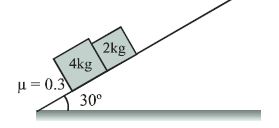
- 7Two blocks, $4\, kg$ and $2\, kg$ are sliding down an inclined plane as shown in figure. The acceleration of $2\, kg$ block is ........ $m/s^2$View Solution
- 8View SolutionIf the normal force is doubled, the coefficient of friction is
- 9The maximum speed of a car on a road-turn of radius $30\, m$, if the coefficient of friction between the tyres and the road is $0.4$, will be .......... $m/sec$View Solution
- 10A block slides down on incline of angle $30^o$ with an acceleration $\frac{g}{4}$. Find the coefficient of kinetic frictionView Solution