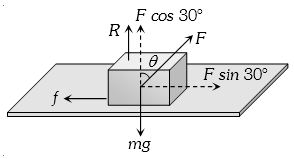
A block of mass $50 \,kg$ can slide on a rough horizontal surface. The coefficient of friction between the block and the surface is $0.6$. The least force of pull acting at an angle of $30^°$ to the upward drawn vertical which causes the block to just slide is ........ $N$
Medium


Download our appand get started for free
Experience the future of education. Simply download our apps or reach out to us for more information. Let's shape the future of learning together!No signup needed.*
Similar Questions
- 1A box when dropped from a certain height reaches the ground with a speed $v$. When it slides from rest from the same height down a rough inclined plane inclined at angle $45^{\circ}$ to the horizontal, it reaches the ground with a speed $v / 3$. The coefficient of sliding friction between the box and the plane is (Take, acceleration due to gravity is $10 \,ms ^{-2}$ )View Solution
- 2A body of mass $2$ kg is moving on the ground comes to rest after some time. The coefficient of kinetic friction between the body and the ground is $0.2$. The retardation in the body is ...... $m/s^2$View Solution
- 3A car of $800 \mathrm{~kg}$ is taking turn on a banked road of radius $300 \mathrm{~m}$ and angle of banking $30^{\circ}$. If coefficient of static friction is $0.2$ then the maximum speed with which car can negotiate the turn safely : $\left(\mathrm{g}=10 \mathrm{~m} / \mathrm{s}^2, \sqrt{3}=1.73\right)$View Solution
- 4A rectangular block has a square base measuring $a \times a$ and its height is $h$. It moves on a horizontal surface in a direction perpendicular to one of the edges. The coefficient of friction is $\mu$. It will topple ifView Solution
- 5A block of mass $10\, kg$ moving at $10\,m/s$ is released to slide on rough surface having coefficient of friction $0.2.$ It will stop by travelling distance ........ $m$View Solution
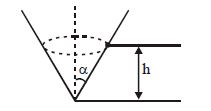
- 6A particle is describing circular motion in a horizontal plane in contact with the smooth inside surface of a fixed right circular cone with its axis vertical and vertex down. The height of the plane of motion above the vertex is $h$ and the semivertical angle of the cone is $\alpha $ . The period of revolution of the particleView Solution
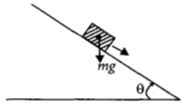
- 7A plank with a box on it at one end is gradually raised about the other end. As the angle of inclination with the horizontal reaches $30^o $, the box starts to slip and slides $4.0\, m $ down the plank in $4.0\, s.$ The coefficients of static and kinetic friction between the box and the plank will be, respectivelyView Solution
- 8A cyclist riding the bicycle at a speed of $14 \sqrt{3} \,m / s$ takes a turn around a circular road of radius $20 \sqrt{3} \,m$ without skidding. What is his inclination to the vertical?View Solution
- 9Two balls of masses ${m_1}$ and ${m_2}$ are separated from each other by a powder charge placed between them. The whole system is at rest on the ground. Suddenly the powder charge explodes and masses are pushed apart. The mass ${m_1}$ travels a distance ${s_1}$ and stops. If the coefficients of friction between the balls and ground are same, the mass ${m_2}$ stops after travelling the distanceView Solution
- 10Aball of mass $m$ is thrown vertically upwards.Assume the force of air resistance has magnitude proportional to the velocity, and direction opposite to the velocity's. At the highest point, the ball's acceleration isView Solution