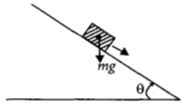
A plank with a box on it at one end is gradually raised about the other end. As the angle of inclination with the horizontal reaches $30^o $, the box starts to slip and slides $4.0\, m $ down the plank in $4.0\, s.$ The coefficients of static and kinetic friction between the box and the plank will be, respectively
AIPMT 2015, Difficult
Download our app for free and get started
Let $µ_s$ and $µ_k$ be the coefficients of static and kinetic friction between the box and the plank respectively.
When the angle of inclination $0$ reaches $30°$, the block just slides, $\mu_s=\tan\theta =\tan 30^o = \frac{1}{\sqrt3}=0.6$
When the angle of inclination $0$ reaches $30°$, the block just slides, $\mu_s=\tan\theta =\tan 30^o = \frac{1}{\sqrt3}=0.6$
If $a$ is the acceleration produced in the block, then
$ma = mg\sin\theta -f_k$
(where $f_k $ is force of kinetic friction)
$= mg\sin0 -μ_k N$ $(as\ \ f_k. = μ_k N)$
$= mg\sin0 - μ_kmg\cos\theta$ $(as\ \ N = mgcos\theta)$
$a = g(\sin\theta - μ_k\cos\theta)$
As $ g = 10 ms^{- 2}$ and $0 = 30°$
$a = ( 10 ms^{- 2})(sin30^o -μ_kcos30^o)$ ..........$(i)$
If $s$ is the distance travelled by the block in time $t$, then
$S=\frac{1}{2} at^2$ $(u=0)$
$a=\frac{2s}{t^2}$
But $s=4.0 \ m$ and $t=4.0 \ s$ (given)
$a=\frac{2(4.0\ m)}{(4.0\ s)^2}=\frac{1}{2}\ ms^{-2}$
Substituting this value of $a$ in eqn. $(i)$, we get
$\frac{1}{2}\ ms^{-2} =10\ ms^{-2}\left( \frac{1}{2}-\mu_k \frac{\sqrt3}{2} \right)$
$\frac{1}{10}=1-\sqrt3 \mu_k$ or $\sqrt3 \mu_k=1-\frac{1}{10}=\frac{9}{10}=0.9$
$\mu_k =\frac{0.9}{\sqrt3}=0.5$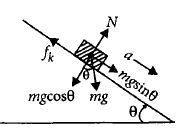

Download our appand get started for free
Experience the future of education. Simply download our apps or reach out to us for more information. Let's shape the future of learning together!No signup needed.*
Similar Questions
- 1In the given figure the acceleration of $M$ is $(g = 10 \,ms^{-2})$View Solution
- 2A block of mass $10 \,kg$ is kept on a fixed rough $(\mu=0.8)$ inclined plane of angle of inclination $30^{\circ}$. The frictional force acting on the block is ........... $N$View Solution
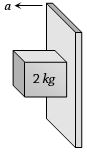
- 3A rough vertical board has an acceleration $‘a’$ so that a $2$ kg block pressing against it does not fall. The coefficient of friction between the block and the board should beView Solution
- 4On the horizontal surface of a truck a block of mass $1 \;kg$ is placed $(\mu=0.6)$ and truck is moving with acceleration $5\; m / sec ^2$ then the frictional force on the block will beView Solution
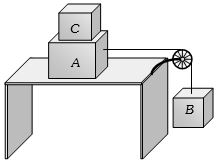
- 5Two masses $A$ and $B$ of $10\, kg$ and $5 \,kg$ respectively are connected with a string passing over a frictionless pulley fixed at the corner of a table as shown. The coefficient of static friction of $A$ with table is $0.2$. The minimum mass of $C$ that may be placed on $A$ to prevent it from moving is ........ $kg$View Solution
- 6A block of mass $M$ rests on a rough horizontal table. A steadily increasing horizontal force is applied such that the block starts to slide on the table without toppling. The force is continued even after sliding has started. Assume the coefficients of static and kinetic friction between the table and the block to be equal. The correct representation of the variation of the frictional force $f$, exerted by the table on the block with time $t$ is given byView Solution
- 7View SolutionOn a railway curve, the outside rail is laid higher than the inside one so that resultant force exerted on the wheels of the rail car by the tops of the rails will
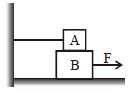
- 8A block $A$ of mass $100\, kg$ rests on another block $B$ of mass $200\, kg$ and is tied to a wall as shown in the figure. The coefficient of friction between $A$ and $B$ is $0.2$ and that between $B$ and the ground is $0.3$. The minimum force $F$ required to move the block $B$ is........ $N$ . $(g = 10\, m/s^2)$View Solution
- 9A block of $200\, g$ mass moves with a uniform speed in a horizontal circular groove, with vertical side walls of radius $20\, cm$. If the block takes $40\, s$ to complete one round, the normal force by the side walls of the groove isView Solution
- 10Abody is placed on a rough inclined plane of inclination $\theta$ .As the angle $\theta$ is increased from $0^o$ to $90^o$ the contact force between the block and the planeView Solution