A block of mass $m$ is placed on a surface having vertical cross section given by $y=x^2 / 4$. If coefficient of friction is $0.5$ , the maximum height above the ground at which block can be placed without slipping is:
JEE MAIN 2024, Diffcult


Download our appand get started for free
Experience the future of education. Simply download our apps or reach out to us for more information. Let's shape the future of learning together!No signup needed.*
Similar Questions
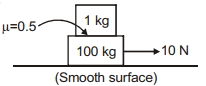
- 1The frictional force acting on $1 \,kg$ block is .................. $N$View Solution
- 2Statement $I :$ A cyclist is moving on an unbanked road with a speed of $7\, kmh ^{-1}$ and takes a sharp circular turn along a path of radius of $2 \,m$ without reducing the speed. The static friction coefficient is $0.2$ . The cyclist will not slip and pass the curve $\left( g =9.8\, m / s ^{2}\right)$View Solution
Statement $II :$ If the road is banked at an angle of $45^{\circ}$, cyclist can cross the curve of $2\, m$ radius with the speed of $18.5\, kmh ^{-1}$ without slipping.
In the light of the above statements, choose the correct answer from the options given below.
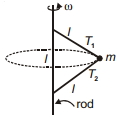
- 3In the figure, a ball of mass $m$ is tied with two strings of equal length as shown. If the rod is rotated with angular velocity $\omega$, thenView Solution
- 4Pulling force making an angle $\theta $ to the horizontal is applied on a block of weight $W$ placed on a horizontal table. If the angle of friction is $\alpha $, then the magnitude of force required to move the body is equal toView Solution
- 5View SolutionWhich one of the following is not used to reduce friction
- 6View SolutionA man balances himself in a horizontal position by pushing his hands and feet against two parallel walls. His centre of mass lies midway between the walls. The coefficients of friction at the walls are equal. Which of the following is not correct?

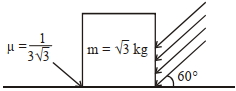
- 7As shown in the figure, a block of mass $\sqrt{3}\, kg$ is kept on a horizontal rough surface of coefficient of friction $\frac{1}{3 \sqrt{3}}$. The critical force to be applied on the vertical surface as shown at an angle $60^{\circ}$ with horizontal such that it does not move, will be $3 x$. The value of $3x$ will beView Solution
$\left[ g =10 m / s ^{2} ; \sin 60^{\circ}=\frac{\sqrt{3}}{2} ; \cos 60^{\circ}=\frac{1}{2}\right]$
- 8A uniform rope of length l lies on a table. If the coefficient of friction is $\mu $, then the maximum length ${l_1}$ of the part of this rope which can overhang from the edge of the table without sliding down isView Solution
- 9View SolutionWhen a body is moving on a surface, the force of friction is called
- 10A horizontal force of $129.4 \,N $ is applied on a $10\, kg$ block which rests on a horizontal surface. If the coefficient of friction is $0.3$, the acceleration should be ....... $m/s^2$View Solution