A horizontal force of $129.4 \,N $ is applied on a $10\, kg$ block which rests on a horizontal surface. If the coefficient of friction is $0.3$, the acceleration should be ....... $m/s^2$
Medium
Download our app for free and get started
(b) From the relation $F - \mu mg = ma$
$a = \frac{{F - \mu mg}}{m} = \frac{{129.4 - 0.3 \times 10 \times 9.8}}{{10}} = 10\;m/{s^2}$

Download our appand get started for free
Experience the future of education. Simply download our apps or reach out to us for more information. Let's shape the future of learning together!No signup needed.*
Similar Questions
- 1A curved in a level road has a radius $75\, m$. The maximum speed of a car turning this curved road can be $30 \,m / s$ without skidding. If radius of curved road is changed to $48\, m$ and the coefficient of friction between the tyres and the road remains same, then maximum allowed speed would be .........$m / s$.View Solution
- 2A uniform rope of total length $l$ is at rest on a table with fraction $f$ of its length hanging (see figure). If the coefficient of friction between the table and the chain is $\mu$, thenView Solution
- 3$A$ block of mass $M$ is placed on $a$ horizontal surface and it is tied with an inextensible string to $a$ block of mass, as shown in figure. A block of mass $m_0$ is also placed on $M$ In previous problem, the tension in the string will beView Solution

- 4A body of mass M is kept on a rough horizontal surface (friction coefficient $\mu $). A person is trying to pull the body by applying a horizontal force but the body is not moving. The force by the surface on the body is $F$, whereView Solution
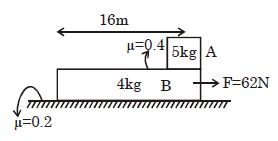
- 5Initially the whole system is at rest and now a force of $62\ N$ is applied on the block $B$ as shown in the figure. Find the time taken by $'A'$ to fall from the block $'B'$ ........... $\sec$View Solution
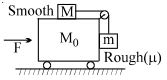
- 6Imagine $a$ situation in which the horizontal surface of block $M_0$ is smooth and its vertical surface is rough with $a$ coefficient of friction $\mu$ Identify the correct statement $(s)$View Solution
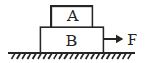
- 7In figure, the coefficient of friction between the floor and the block $B$ is $0.1$. The coefficient of friction between the blocks $B$ and $A$ is $0.2$. The mass of $A$ is $\frac{m}{2}$ and of $B$ is $m$. ........ $mg$ is the maximum horizontal force $F$ can be applied to the block $B$ so that two blocks move together ?View Solution
- 8A car is moving along a straight horizontal road with a speed ${v_0}$. If the coefficient of friction between the tyres and the road is $\mu $, the shortest distance in which the car can be stopped isView Solution
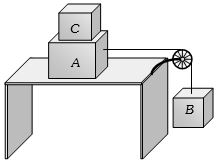
- 9Two masses $A$ and $B$ of $10\, kg$ and $5 \,kg$ respectively are connected with a string passing over a frictionless pulley fixed at the corner of a table as shown. The coefficient of static friction of $A$ with table is $0.2$. The minimum mass of $C$ that may be placed on $A$ to prevent it from moving is ........ $kg$View Solution
- 10Two bodies of equal masses revolve in circular orbits of radii ${R_1}$ and ${R_2}$ with the same period. Their centripetal forces are in the ratioView Solution