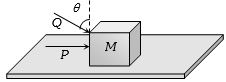
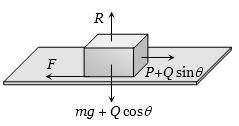
A block of mass $m$ lying on a rough horizontal plane is acted upon by a horizontal force $P$ and another force $Q$ inclined at an angle $\theta $ to the vertical. The block will remain in equilibrium, if the coefficient of friction between it and the surface is
Diffcult


Download our appand get started for free
Experience the future of education. Simply download our apps or reach out to us for more information. Let's shape the future of learning together!No signup needed.*
Similar Questions
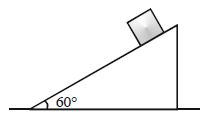
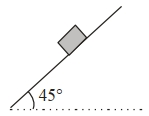
- 1Consider a block kept on an inclined plane (inclined at $45^{\circ}$ ) as shown in the figure. If the force required to just push it up the incline is $2$ times the force required to just prevent it from sliding down, the coefficient of friction between the block and inclined plane $(\mu)$ is equal toView Solution
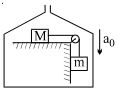
- 2In figure, two blocks $M$ and $m$ are tied together with an inextensible and light string. The mass $M$ is placed on a rough horizontal surface with coefficient of friction $\mu$ and the mass $m$ is hanging vertically against a smooth vertical wall. The pulley is frictionless. Imagine a situation in which the given arrangement is placed inside an elevator that can move only in the vertical direction and compare the situation with the case when it is placed on the ground. When the elevator accelerates downward with $a_0( < g)$, thenView Solution
- 3$STATEMENT-1$ It is easier to pull a heavy object than to push it on a level ground. andView Solution
$STATEMENT-2$ The magnitude of frictional force depends on the nature of the two surfaces in contact.
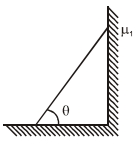
- 4In the figure, a ladder of mass $m$ is shown leaning against a wall. It is in static equilibrium making an angle $\theta$ with the horizontal floor. The coefficient of friction between the wall and the ladder is $\mu_1$ and that between the floor and the ladder is $\mu_2$. The normal reaction of the wall on the ladder is $N_1$ and that of the floor is $N_2$. If the ladder is about to slip, thenView Solution
$Image$
$(A)$ $\mu_1=0 \mu_2 \neq 0$ and $N _2 \tan \theta=\frac{ mg }{2}$
$(B)$ $\mu_1 \neq 0 \mu_2=0$ and $N_1 \tan \theta=\frac{m g}{2}$
$(C)$ $\mu_1 \neq 0 \mu_2 \neq 0$ and $N _2 \tan \theta=\frac{ mg }{1+\mu_1 \mu_2}$
$(D)$ $\mu_1=0 \mu_2 \neq 0$ and $N _1 \tan \theta=\frac{ mg }{2}$
- 5The coefficient of static friction between a wooden block of mass $0.5\, kg$ and a vertical rough wall is $0.2$ The magnitude of horizontal force that should be applied on the block to keep it adhere to the wall will be $N$ $\left[ g =10\, ms ^{-2}\right]$View Solution
- 6View SolutionThe limiting friction between two bodies in contact is independent of
- 7An inclined plane is bent in such a way that the vertical cross-section is given by $y =\frac{ x ^{2}}{4}$ where $y$ is in vertical and $x$ in horizontal direction. If the upper surface of this curved plane is rough with coefficient of friction $\mu=0.5,$ the maximum height in $cm$ at which a stationary block will not slip downward is............$cm$View Solution
- 8The maximum speed of a car on a road-turn of radius $30\, m$, if the coefficient of friction between the tyres and the road is $0.4$, will be .......... $m/sec$View Solution
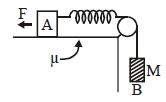
- 9Block $A$ of mass $m$ and block $B$ of mass $M$ are connected by a massless spring over a pulley on a rough plane with coefficient of friction as $μ$. A force $F$ is applied on block $A$ to the left. Find the minimum value of $M$ to move the block $A$ towards rightView Solution
- 10A block slides down an inclined plane with an acceleration $g/2$ as shown in fig. Then coefficient of kinetic friction isView Solution