A car sometimes overturns while taking a turn. When it overturns, it is
Easy


Download our appand get started for free
Experience the future of education. Simply download our apps or reach out to us for more information. Let's shape the future of learning together!No signup needed.*
Similar Questions
- 1A ball of mass $0.25\, kg$ attached to the end of a string of length $1.96 \,m$ is moving in a horizontal circle. The string will break if the tension is more than $25 \,N$. .......... $m/s$ is the maximum speed with which the ball can be movedView Solution
- 2View SolutionA metal block is resting on a rough wooden surface. A horizontal force applied to the block is increased uniformly. Which of the following curves correctly represents velocity of the block ?
- 3View SolutionA motor cycle driver doubles its velocity when he is having a turn. The force exerted outwardly will be
- 4Consider a car moving along a straight horizontal road with a speed of $72\, km/h$. If the coefficient of kinetic friction between the tyres and the road is $0.5,$ the shortest distance in which the car can be stopped is ........ $m$ .$[g = 10\,m{s^{ - 2}}]$View Solution
- 5An object of mass $1 \,kg$ moving on a horizontal surface with initial velocity $8 \,m / s$ comes to rest after $10 \,s$. If one wants to keep the object moving on the same surface with velocity $8 \,m / s$ the force required is ...... $N$View Solution
- 6A body of mass $40\,kg$ resting on rough horizontal surface is subjected to a force $P$ which is just enough to start the motion of the body. If $\mu_{ s }=5, \mu_{ x }=0.4$, $g =10\,m / s ^2$ and the force $P$ is continuously applied on the body, then the acceleration of the body is $.........m/s^{2}$View Solution
- 7A block of mass $M$ slides down on a rough inclined plane with constant velocity. The angle made by the incline plane with horizontal is $\theta$. The magnitude of the contact force will be.View Solution
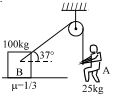
- 8Block $B$ of mass $100 kg$ rests on a rough surface of friction coefficient $\mu = 1/3$. $A$ rope is tied to block $B$ as shown in figure. The maximum acceleration with which boy $A$ of $25 kg$ can climbs on rope without making block move is:View Solution
- 9View SolutionThe limiting value of static friction between two contact surfaces is ...........
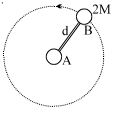
- 10The dumbell is placed on a frictionless horizontal table. Sphere $A$ is attached to a frictionless pivot so that $B$ can be made to rotate about $A$ with constant angular velocity. If $B$ makes one revolution in period $P$, the tension in the rod isView Solution