The maximum tension which an inextensible ring of mass $0.1\, kg/m$ can bear is $10\,N$. The maximum velocity in $m/s$ with which it can be rotated is ........ $m/s.$
Diffcult


Download our appand get started for free
Experience the future of education. Simply download our apps or reach out to us for more information. Let's shape the future of learning together!No signup needed.*
Similar Questions
- 1A block of mass $2 kg$ slides down an incline plane of inclination $30^o$. The coefficient of friction between block and plane is $0.5$. The contact force between block and plank is :View Solution
- 2A uniform rod of length $l$ is being rotated in a horizontal plane with a constant angular speed about an axis passing through one of its ends. If the tension generated in the rod due to rotation is $T(x)$ at a distance $x$ from the axis, then which of the following graphs depicts it most closely?View Solution
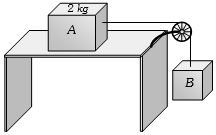
- 3The coefficient of static friction, ${\mu _s},$ between block $A$ of mass $2\, kg$ and the table as shown in the figure is $0.2$. ........ $kg$ would be the maximum mass value of block $B$ so that the two blocks do not move. The string and the pulley are assumed to be smooth and massless. $(g = 10\,m/{s^2})$View Solution
- 4A train is running at $20 \,m / s$ on a railway line with radius of curvature $40,000$ metres. The distance between the two rails is $1.5$ metres. For safe running of train the elevation of outer rail over the inner rail is ......$mm$ $\left( g =10 \,m / s ^2\right)$View Solution
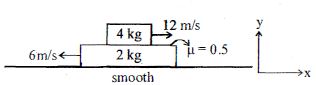
- 5The blocks are given velocity in the direction shown in figure. Co-efficient of friction between two blocks shown in figure is $μ = 0.5$. Take $g = 10\ m/s^2$View Solution
(considering $4\ kg$ block doesn't fall on ground)
Consider the following statements
$(i)$ Time when relative motion between them is stopped is $1.4\ second$.
$(ii)$ Time when relative motion between them is stopped in $1.2\ second$
$(iii)$ The common velocity of the two blocks is $8\ m/s$, towards right.
$(iv)$ The displacement of the $4\, kg$ block when relative motion stopped is$10.8\ m$.
Which of the fstatements is/are correct
- 6When a body slides down from rest along a smooth inclined plane making an angle of $30^{\circ}$ with the horizontal, it takes time $T$. When the same body slides down from the rest along a rough inclined plane making the same angle and through the same distance, it takes time $\alpha {T}$, where $\alpha$ is a constant greater than $1 .$ The co-efficient of friction between the body and the rough plane is $\frac{1}{\sqrt{{x}}}\left(\frac{\alpha^{2}-1}{\alpha^{2}}\right)$ where ${x}=..... .$View Solution
- 7A car is moving on a horizontal circular road of radius $0.1 \,km$ with constant speed. If coefficient of friction between tyres of car and road is $0.4$, then speed of car may be ......... $m / s$ $\left(g=10 \,m / s ^2\right)$View Solution
- 8A $100 \,kg$ car is moving with a maximum velocity of $9 \,m/s$ across a circular track of radius $30\,m$. The maximum force of friction between the road and the car is ........ $N$View Solution
- 9A block slides down on incline of angle $30^o$ with an acceleration $\frac{g}{4}$. Find the coefficient of kinetic frictionView Solution
- 10A block is at rest on an inclined plane making an angle $\alpha $ with the horizontal. As the angle $\alpha $ of the incline is increased, the block starts slipping when the angle of inclination becomes $\theta $. The coefficient of static friction between the block and the surface of the inclined plane isView Solution