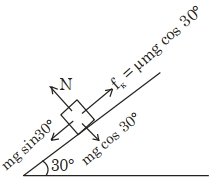
A block of mass $m$ slides down the plane inclined at angle $30^{\circ}$ with an acceleration $\frac{ g }{4}$. The value of coefficient of kinetic friction will be :
JEE MAIN 2023, Medium


Download our appand get started for free
Experience the future of education. Simply download our apps or reach out to us for more information. Let's shape the future of learning together!No signup needed.*
Similar Questions
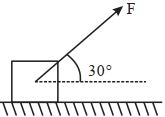
- 1As shown in the figure a block of mass $10\,kg$ lying on a horizontal surface is pulled by a force $F$ acting at an angle $30^{\circ}$, with horizontal. For $\mu_{ s }=0.25$, the block will just start to move for the value of $F..........\,N$ : $\left[\right.$ Given $\left.g =10\,ms ^{-2}\right]$View Solution
- 2View SolutionChoose the correct statement.
- 3A body of mass $40\,kg$ resting on rough horizontal surface is subjected to a force $P$ which is just enough to start the motion of the body. If $\mu_{ s }=5, \mu_{ x }=0.4$, $g =10\,m / s ^2$ and the force $P$ is continuously applied on the body, then the acceleration of the body is $.........m/s^{2}$View Solution
- 4A horizontal force of $4\,N$ is needed to keep a block of mass $0.5\, kg$ sliding on a horizontal surface with a constant speed. The coefficient of sliding friction must be :- $[g = 10\, m/s^2]$View Solution
- 5A car of weight $W$ is on an inclined road that rises by $100\,m$ over a distance of $1\,Km$ and applies a constant frictional force $\frac {W}{20}$ on the car. While moving uphill on the road at a speed of $10\,ms^{-1},$ the car needs power $P.$ If it needs power $\frac {P}{2}$ while moving down hill at speed $v$ then value of $v$ is ........ $ms^{-1}$View Solution
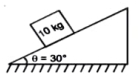
- 6A block of mass $10 \,kg$ is kept on a fixed rough $(\mu=0.8)$ inclined plane of angle of inclination $30^{\circ}$. The frictional force acting on the block is ........... $N$View Solution
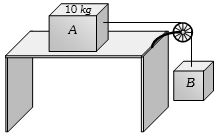
- 7If mass of $A = 10\,\,kg$, coefficient of static friction $= 0.2$, coefficient of kinetic friction = $0.2$. Then mass of $B$ to start motion isView Solution
- 8A rod $(AB)$ is attached to a fixed point $(C)$ using a light rope $(AC)$. The other end of the rod $(B)$ is sitting on ice with negligible friction and the system is in stationary position. Which of the following can be the equilibrium configuration of this system?View Solution
- 9When a body is placed on a rough plane inclined at an angle $\theta $ to the horizontal, its acceleration isView Solution
- 10$A$ block of mass $M$ is placed on $a$ horizontal surface and it is tied with an inextensible string to $a$ block of mass, as shown in figure. A block of mass $m_0$ is also placed on $M$ The minimum value of $\mu$ between the block $M$ and $m_0$ (taking horizontal surface frictionless) for which all the three blocks move together, isView Solution
