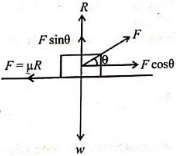
A block of weight $W$ rests on a horizontal floor with coefficient of static friction $\mu .$ It is desired to make the block move by applying minimum amount of force. The angle $\theta $ from the horizontal at which the force should be applied and magnitude of the force $F$ are respectively.
AIEEE 2012, Difficult
Download our app for free and get started
Let the force $F$ is applied at an angle $\theta$ with the horizontal.
For horizontal equilibrium,
$F \cos \theta=\mu R$
For vertical equilibrium,
$R+F \sin \theta=m g$
$\text { or }, R=m g-F \sin \theta$
Substituting this value of $R$ in eq. $(i),$
we get
$F \cos =\mu(m g-F \sin \theta)$
$=\mu m g-\mu F \sin \theta$
or, $F(\cos \theta+\mu \sin \theta)=\mu m g$
or, $F=\frac{\mu m g}{\cos \theta+\mu \sin \theta}$
For $F$ to be minimum, the denominator $(\cos \theta+\mu \sin \theta)$ should be maximum.
$\therefore \frac{d}{d \theta}(\cos \theta+\mu \sin \theta)=0$
or, $-\sin \theta+\mu \cos \theta=0$
or, $\tan \theta=\mu$
or, $\theta=\tan ^{-1}(\mu)$
Then, $\sin \theta=\frac{\mu}{\sqrt{1+\mu^2}}$ and
$\cos \theta=\frac{1}{\sqrt{1+\mu^2}}$
Hence, $F_{\text {min }}$
$=\frac{\mu w}{\frac{1}{\sqrt{1+\mu^2}}+\frac{\mu^2}{\sqrt{1+\mu^2}}}=\frac{\mu w}{\sqrt{1+\mu^2}}$
For horizontal equilibrium,
$F \cos \theta=\mu R$
For vertical equilibrium,
$R+F \sin \theta=m g$
$\text { or }, R=m g-F \sin \theta$
Substituting this value of $R$ in eq. $(i),$
we get
$F \cos =\mu(m g-F \sin \theta)$
$=\mu m g-\mu F \sin \theta$
or, $F(\cos \theta+\mu \sin \theta)=\mu m g$
or, $F=\frac{\mu m g}{\cos \theta+\mu \sin \theta}$
For $F$ to be minimum, the denominator $(\cos \theta+\mu \sin \theta)$ should be maximum.
$\therefore \frac{d}{d \theta}(\cos \theta+\mu \sin \theta)=0$
or, $-\sin \theta+\mu \cos \theta=0$
or, $\tan \theta=\mu$
or, $\theta=\tan ^{-1}(\mu)$
Then, $\sin \theta=\frac{\mu}{\sqrt{1+\mu^2}}$ and
$\cos \theta=\frac{1}{\sqrt{1+\mu^2}}$
Hence, $F_{\text {min }}$
$=\frac{\mu w}{\frac{1}{\sqrt{1+\mu^2}}+\frac{\mu^2}{\sqrt{1+\mu^2}}}=\frac{\mu w}{\sqrt{1+\mu^2}}$

Download our appand get started for free
Experience the future of education. Simply download our apps or reach out to us for more information. Let's shape the future of learning together!No signup needed.*
Similar Questions
- 1A lift is moving downwards with an acceleration equal to acceleration due to gravity. $A$ body of mass $M$ kept on the floor of the lift is pulled horizontally. If the coefficient of friction is $\mu $, if the lift is moving upwards with a uniform velocity, then the frictional resistance offered by the body isView Solution
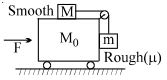
- 2Imagine $a$ situation in which the horizontal surface of block $M_0$ is smooth and its vertical surface is rough with $a$ coefficient of friction $\mu$ In above problem, choose the correct value $(s)$ of F which the blocks $M$ and $m$ remain stationary with respect to $M_0$View Solution
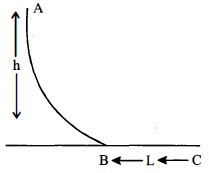
- 3A small ball of mass $m$ starts at a point $A$ with speed $v_0$ and moves along a frictionless track $AB$ as shown. The track $BC$ has coefficient of friction $\mu $. The ball comes to stop at $C$ after travelling a distance $L$ which isView Solution
- 4A stone of mass of $16\, kg$ is attached to a string $144 \,m$ long and is whirled in a horizontal circle. The maximum tension the string can withstand is $16$ Newton. The maximum velocity of revolution that can be given to the stone without breaking it, will be ....... $ms^{-1}$View Solution
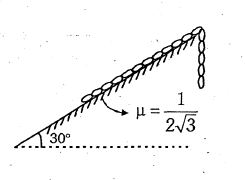
- 5A uniform chain is at rest partially on the incline and partially hanging vertically. Coefficient of friction between chain and incline is $\mu = \frac{1}{{2\sqrt 3 }}$. The ratio of $\frac{{{L_{\max }}}}{{{L_{\min }}}}$ is $(L_{max} =$ maximum length of chain kept on inclined so that chain remains at rest, $L_{min} =$ minimum length of chain kept on incline so that chain remains at rest)View Solution
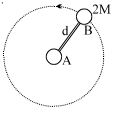
- 6The dumbell is placed on a frictionless horizontal table. Sphere $A$ is attached to a frictionless pivot so that $B$ can be made to rotate about $A$ with constant angular velocity. If $B$ makes one revolution in period $P$, the tension in the rod isView Solution
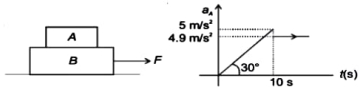
- 7Acceleration of block $A$ varies with time as shown in figure the value of coefficient of kinetic friction between block $A$ and $B$ is the value of coefficient of kinetic friction between block $A$ and $B$ is ..............View Solution
- 8A car turns a corner on a slippery road at a constant speed of $10\,m/s$. If the coefficient of friction is $0.5$, the minimum radius of the arc in meter in which the car turns isView Solution
- 9A small block of mass $m$ is projected horizontally with speed $u$ where friction coefficient between block and plane is given by $\mu = cx$, where $x$ is displacement of the block on plane. Find maximum distance covered by the blockView Solution
- 10Two masses $M$ and $m$ are attached to a vertical axis by weightless threads of combined length $l$. They are set in rotational motion in a horizontal plane about this axis with constant angular velocity $\omega $. If the tensions in the threads are the same during motion, the distance of $M$ from the axis isView Solution