Two masses $M$ and $m$ are attached to a vertical axis by weightless threads of combined length $l$. They are set in rotational motion in a horizontal plane about this axis with constant angular velocity $\omega $. If the tensions in the threads are the same during motion, the distance of $M$ from the axis is
Difficult
Download our app for free and get started
(b )If the both mass are revolving about the axis $yy'$ and tension in both the threads are equal then
$M{\omega ^2}x = m{\omega ^2}(l - x)$
$⇒$ $Mx = m(l - x)$
$⇒$ $x = \frac{{ml}}{{M + m}}$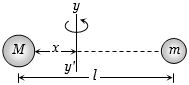

Download our appand get started for free
Experience the future of education. Simply download our apps or reach out to us for more information. Let's shape the future of learning together!No signup needed.*
Similar Questions
- 1A particle is moving along the circle $x^2 + y^2 = a^2$ in anti clock wise direction. The $x-y$ plane is a rough horizontal stationary surface. At the point $(a\, cos\theta , a\, sin\theta )$, the unit vector in the direction of friction on the particle is:View Solution
- 2View SolutionWhich one of the following is not used to reduce friction
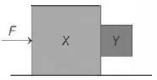
- 3Consider the system shown below. A horizontal force $F$ is applied to a block $X$ of mass $8 \,kg$, such that the block $Y$ of mass $2 \,kg$ adjacent to it does not slip downwards under gravity. There is no friction between the horizontal plane and the base of the block $X$. The coefficient of friction between the surfaces of blocks $X$ and $Y$ is $0.5$. The minimum value of $F$ is ............ $N$ (take, acceleration due to gravity to be $10 \,ms ^{-2}$ )View Solution
- 4A block of mass $10\, kg$ is placed on a rough horizontal surface having coefficient of friction $\,\mu = 0.5$. If a horizontal force of $100\, N$ is acting on it, then acceleration of the block will be ....... $m/s^2$View Solution
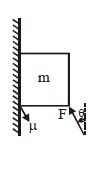
- 5A block of mass $m$ (initially at rest) is sliding up (in vertical direction) against a rough vertical wall with the help of a force $F$ whose magnitude is constant but direction is changing. $\theta = {\theta _0}t$ where $t$ is time in sec. At $t$ = $0$ , the force is in vertical upward direction and then as time passes its direction is getting along normal, i.e., $\theta = \frac{\pi }{2}$ .The value of $F$ so that the block comes to rest when $\theta = \frac{\pi }{2}$ , isView Solution
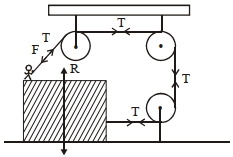
- 6A boy of mass $4\, kg$ is standing on a piece of wood having mass $5 \,kg$. If the coefficient of friction between the wood and the floor is $0.5,$ the maximum force that the boy can exert on the rope so that the piece of wood does not move from its place is ......$N.$(Round off to the Nearest Integer) [Take $g=10 \,ms ^{-2}$ ]View Solution
- 7A block of mass $M$ rests on a rough horizontal table. A steadily increasing horizontal force is applied such that the block starts to slide on the table without toppling. The force is continued even after sliding has started. Assume the coefficients of static and kinetic friction between the table and the block to be equal. The correct representation of the variation of the frictional force $f$, exerted by the table on the block with time $t$ is given byView Solution
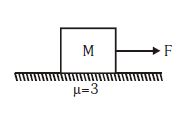
- 8A block of mass $M$ placed on rough surface of coefficient of friction equal to $3$ . If $F$ is the $(4/5)$ of the minimum force required to just move. Find out the force exerted by ground on the blockView Solution
- 9A sphere of mass $m$ is set in motion with initial velocity $v_o$ on a surface on which $kx^n$ is the frictional force with $k$ and $n$ as the constants and $x$ as the distance from the point of start. Find the distance in which sphere will stopView Solution
- 10View SolutionA man pulls a block heavier than himself with a light horizontal rope. The coefficient of friction is the same between the man and the ground, and between the block and the ground