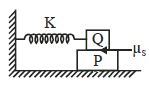
A block $P$ of mass $m$ is placed on a smooth horizontal surface. A block $Q$ of same mass is placed over the block $P$ and the coefficient of static friction between them is ${\mu _S}$. A spring of spring constant $K$ is attached to block $Q$. The blocks are displaced together to a distance $A$ and released. The upper block oscillates without slipping over the lower block. The maximum frictional force between the block is
Diffcult


Download our appand get started for free
Experience the future of education. Simply download our apps or reach out to us for more information. Let's shape the future of learning together!No signup needed.*
Similar Questions
- 1View SolutionThe total energy of a particle, executing simple harmonic motion is
- 2The period of a simple pendulum measured inside a stationary lift is found to be $T$. If the lift starts accelerating upwards with acceleration of $g/3,$ then the time period of the pendulum isView Solution
- 3If displacement $x$ and velocity $v$ are related as $4v^2 = 25 -x^2$ in a $SHM$. Then time Period of given $SHM$ is (Consider $SI\, units$)View Solution
- 4The period of oscillation of a simple pendulum of constant length at earth surface is $T$. Its period inside a mine isView Solution
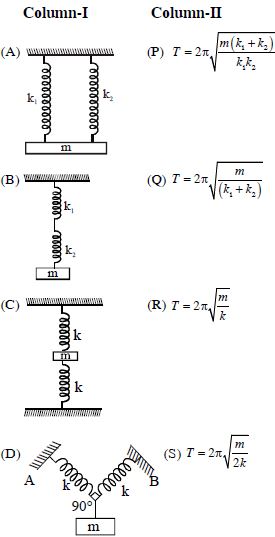
- 5In the following questions, match column $-I$ with column $-II$ and choose the correct optionsView Solution
- 6The angular velocities of three bodies in simple harmonic motion are ${\omega _1},\,{\omega _2},\,{\omega _3}$ with their respective amplitudes as ${A_1},\,{A_2},\,{A_3}$. If all the three bodies have same mass and velocity, thenView Solution
- 7The total energy of particle performing $S.H.M.$ depend onView Solution
- 8A simple pendulum consisting of a light inextensible string of length $\ell$ attached to a heavy small bob of mass $m$ is at rest. The bob is imparted a horizontal impulsive force which gives it a speed of $\sqrt{4 g \ell}$. The speed of the bob at its highest point is ( $g$ is the accelaration due to gravity)View Solution
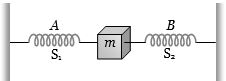
- 9In the figure, ${S_1}$ and ${S_2}$ are identical springs. The oscillation frequency of the mass $m$ is $f$. If one spring is removed, the frequency will becomeView Solution
- 10A particle of mass $250\,g$ executes a simple harmonic motion under a periodic force $F =(-25\,x) N$. The particle attains a maximum speed of $4\,m / s$ during its oscillation. The amplitude of the motion is $...........cm$.View Solution