MCQ
A block slides down a smooth inclined plane when released from the top, while another falls freely from the same point
  • A
    sliding block will reach the ground first with greater speed
  • B
    freely falling block will reach the ground first with greater speed
  • C
    both the blocks will reach the ground at the same time but with different speeds
  • both the blocks will reach the ground with same speed but the freely falling block first

Answer

Correct option: D.
both the blocks will reach the ground with same speed but the freely falling block first
d
In case of sliding motion on an inclined plane,

${\mathrm{h}=\mathrm{s}=\frac{1}{2} \mathrm{g} \sin \theta \mathrm{t}^{2}}$

${\text { or } \mathrm{t}=\mathrm{t_s}=\frac{1}{\sin \theta} \sqrt{\frac{2 \mathrm{h}}{\mathrm{g}}}}$

${\text { and } \mathrm{u}_{\mathrm{s}}=\sqrt{2 \mathrm{gh}}=\sqrt{2(\mathrm{g} \sin \theta) \mathrm{s}}}$

while in case of free fall,

$\mathrm{t}_{\mathrm{F}}=\sqrt{\frac{2 \mathrm{h}}{\mathrm{g}}}$ and $\mathrm{u}_{\mathrm{F}}=\sqrt{2 \mathrm{gh}}$

$\frac{\mathrm{t}_{\mathrm{F}}}{\mathrm{t}_{\mathrm{s}}}=\sin \theta<1 \mathrm{i.e.}, \mathrm{t}_{\mathrm{F}}<\mathrm{t}_{\mathrm{s}}$

i.e., falling body reaches the ground first.

Also $\quad \frac{\mathrm{u}_{\mathrm{F}}}{\mathrm{u}_{\mathrm{s}}}=1,$ i.e., $\mathrm{u}_{\mathrm{F}}=\mathrm{u}_{\mathrm{s}}$

i.e., both reach the ground with same speed (not velocity as for falling body direction is vertical while for sliding body along the plane downwards).

Need a full question paper?

Generate a complete, print-ready paper with questions like this in minutes — across 16+ boards, with answer keys.

Start Generating Free

Similar questions

A new temperature scale uses $X$ as a unit of temperature, where the numerical value of the temperature $t_x$ in this scale is related to the absolute temperature $T$ by $t_x=3 T+100$. If the specific heat of a material using this unit is $1400 \,J kg ^{-1} K ^{-1}$, its specific heat in the SI system of units is
A particle undergoing simple harmonic motion has time dependent displacement given by $x(t)\, = \,A\,\sin \,\frac{{\pi t}}{{90}}$. The ratio of kinetic to potential energy $o$ the particle at $t=210\,s$ will be
Two identical blocks $A$ and $B$ each of mass $m$ resting on the smooth horizontal floor are connected by a light spring of natural length $L$ and spring constant $K$. A third block $C$ of mass $m$ moving with a speed $v$ along the line joining $A$ and $B$ collides with $A$.The maximum compression in the spring is
A carnot engine whose sink is at 300K has an efficiency of 40%. By how much should the temperature of source be increased so as to increase its efficiency by 50% of original efficiency.
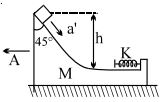
$A$ small block of mass $m$ is placed on $a$ wedge of mass $M$ as shown, which is initially at rest. All the surfaces are frictionless . The spring attached to the other end of wedge has force constant $k$. If $a'$ is the acceleration of $m$ relative to the wedge as it starts coming down and $A$ is the acceleration acquired by the wedge as the block starts coming down, then  Maximum retardation of $M$ is:
A wheel completes $2000$ revolutions to cover the $9.5\, km$. distance. then the diameter of the wheel is
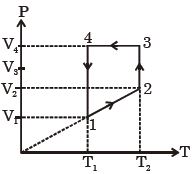
A monoatomic ideal gas of two moles is taken through a cyclic process starting from $1$ as shown. $\frac{{{V_2}}}{{{V_1}}} = 2$ and $\frac{{{V_4}}}{{{V_1}}} = 4$ and temperature iast : $1$ is $T_1 = 27\,^oC$. The temperature at $2$ i.e., $T_2$ ...... $K$
The position vector of a particle changes with time according to the relation $\vec r\left( t \right) = 15{t^2}\hat i + \left( {4 - 20{t^2}} \right)\hat j$. What is the magnitude of the acceleration at $t = 1$ ?
Weight of a body of mass $m$ decreases by $1\%$ when it is raised to height $h$ above  the Earth's surface. If the body is taken to a depth $h$ in a mine, then its weight will
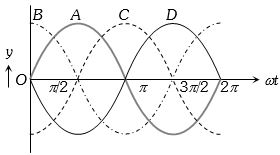
The figure shows four progressive waves $A, B, C$ and $D $ with their phases expressed with respect to the wave $A$. It can be concluded from the figure that