MCQ
A body at rest may have
  • Energy
  • B
    Momentum
  • C
    Speed
  • D
    Velocity

Answer

Correct option: A.
Energy
a
(a)Body at rest may possess potential energy.

Need a full question paper?

Generate a complete, print-ready paper with questions like this in minutes — across 16+ boards, with answer keys.
Start Generating Free

Similar questions

Dynamo core is laminated because
One astronomical unit is a distance equal to ...... $m$
When a metallic surface is illuminated with monochromatic light of wavelength $l$, the stopping potential is $5$ $V_0$. When the same surface is illuminated with light of wavelength $3 \lambda $, the stopping potential is $V_0$. Then the work function of the metallic surface is :
In a vernier callipers, each $cm$ on the main scale is divided into $20$ equal parts. If tenth vernier scale division coincides with nineth main scale division. Then the value of vernier constant will be $\dots \; \times 10^{-2} \;mm$
Identify the $WRONG$ statement
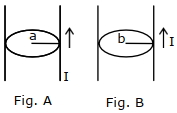
Figure $A$ and $B$ shown two long straight wires of circular cross-section ($a$ and $b$ with $a$ $<$ $b$), carrying current $I$ which is uniformly distributed across the cross-section. The magnitude of magnetic field $B$ varies with radius $r$ and can be represented as
Acceleration due to gravity $'g'$ for a body of mass $'m'$ on earth's surface is proportional to (Radius of earth$=R$, mass of earth$=M$)
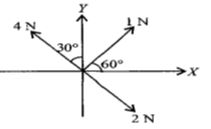
Three forces acting on a body are shown in the figure. To have the resultant force only along the $y-$ direction, the magnitude of the minimum additional force needed is  ........... $N$
A bakelite beaker has volume capacity of $500\, cc$ at $30^{\circ} C$. When it is partially filled with $V _{ m }$ volume (at $30^{\circ}$ ) of mercury, it is found that the unfilled volume of the beaker remains constant as temperature is varied. If $\gamma_{\text {(beaker) }}=6 \times 10^{-6}{ }^{\circ} C ^{-1}$ and $\gamma_{(\text {mercury })}=1.5 \times 10^{-4}{ }^{\circ} C ^{-1},$ where $\gamma$ is the coefficient of volume expansion, then $V _{ m }($in $cc )$ is close to
A cylindrical capacitor has two co-axial cylinders of length $20 \,cm$ and radii $2 r$ and $r$. Inner cylinder is given a charge $10 \,\mu C$ and outer cylinder a charge of $-10 \,\mu C$. The potential difference between the two cylinders will be