Identify the $WRONG$ statement
Medium
Download our app for free and get started
For similar charge, $PE$ increases with decreases in $r.$ For dissimilar charge $PE$ decreases with decrease in $r.$
As $P.E.\, = \,\frac{{{Q_1}{Q_2}}}{{4\pi {\varepsilon _0}r}}$

Download our appand get started for free
Experience the future of education. Simply download our apps or reach out to us for more information. Let's shape the future of learning together!No signup needed.*
Similar Questions
- 1View SolutionA spherical portion has been removed from a solid sphere having a charge distributed uniformly in its volume in the figure. The electric field inside the emptied space is

- 2Two identical capacitors are joined in parallel, charged to a potential $V$ and then separated and then connected in series $i.e.$ the positive plate of one is connected to negative of the otherView Solution
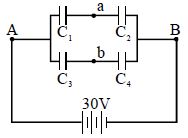
- 3Four capacitors with capacitances $C_1 = 1\,\mu F, C_2 = 1.5\,\mu F, C_3 = 2.5\,\mu F$ and $C_4 = 0.5\,\mu F$ are connected as shown and are connected to a $30\, volt$ source. The potential difference between points $a$ and $b$ is.....$V$View Solution
- 4View SolutionThe capacity of a parallel plate capacitor increases with the
- 5In the $R-C$ circuit shown in the figure the total energy of $3.6 \times 10^{-3}\ J$ is dissipated in the $10$ $\Omega$ resistor when the switch $S$ is closed. The initial charge on the capacitor is.....$\mu C$View Solution

- 6The capacitor of capacitance $4\,\mu F$ and $6\,\mu F$ are connected in series. A potential difference of $500\;volts$ applied to the outer plates of the two capacitor system. Then the charge on each capacitor is numericallyView Solution
- 7Two parallel plate capacitor with different plate seperation but the same capacitance are connected in series to a battery. Both capacitors are filled with air. The quantity that is $NOT$ the same for both the capacitors when they are fully charged isView Solution
- 8A non-conducting ring of radius $0.5\,m$ carries a total charge of $1.11 \times {10^{ - 10}}\,C$ distributed non-uniformly on its circumference producing an electric field $\vec E$ everywhere in space. The value of the line integral $\int_{l = \infty }^{l = 0} {\, - \overrightarrow E .\overrightarrow {dl} } \,(l = 0$ being centre of the ring) in volt isView Solution
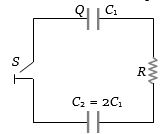
- 9Two capacitors $C_1$ and $C_2 = 2C_1$ are connected in a circuit with a switch between them as shown in the figure. Initially the switch is open and $C_1$ holds charge $Q$. The switch is closed. At steady state, the charge on each capacitor will beView Solution
- 10Two capacitors of capacities ${C_1}$ and ${C_2}$ are charged to voltages ${V_1}$ and ${V_2}$ respectively. There will be no exchange of energy in connecting them in parallel, ifView Solution