MCQ
A body can be negatively charged by
  • Giving excess of electrons to it
  • B
    Removing some electrons from it
  • C
    Giving some protons to it
  • D
    Removing some neutrons from it

Answer

Correct option: A.
Giving excess of electrons to it
a
(a) Excess of electron gives the negative charge on body.

Need a full question paper?

Generate a complete, print-ready paper with questions like this in minutes — across 16+ boards, with answer keys.

Start Generating Free

Similar questions

A small quantity of solution containing $Na^{24}$ radio nuclide of activity $1$ microcurie is injected into the blood of a person. A sample of the blood of volume $1\, cm^3$ taken after $5$ hours shows an activity of $296$ disintegration per minute. What will be the total volume of the blood in the body of the person. Assume that the radioactive solution mixes uniformly in the blood of the person ......... $liter$

(Take $1$ curie $= 3.7 × 10^{10}$ disintegration per second and ${e^{ - \lambda t}} = 0.7927;$ where $\lambda$= disintegration constant)
A body is uniformly rotating about an axis fixed in an inertial frame of reference. Let $\overrightarrow{\text{A}}$ be a unit vector along the axis of rotation and $\overrightarrow{\text{B}}$ be the unit vector along the resultant force on a particle P of the body away from the axis. The value of $\overrightarrow{\text{A}}.\overrightarrow{\text{B}}$ is:
Photo cells are used for the
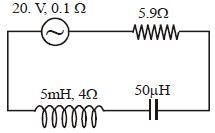
In the circuit of fig, the source frequency is $\omega  = 2000\,rad/s$. The current in the circuit will be....$A$
Number of visible lines in Balmer's series
An achromatic prism is made by crown glass prism $({A_c} = {19^o})$ and flint glass prism $({A_F} = {6^o})$. If $^C{\mu _v} = 1.5$ and $^F{\mu _v} = 1.66$, then resultant deviation for red coloured ray will be......$^o$
Ionisation energy of 10 times ionised sodium atom will be :
A charge of $1\,C$ is moving in a magnetic field of $0.5\,Tesla$ with a velocity of $10\,m/sec$ Perpendicular to the field. Force experienced is.....$N$
Two free positive charges $4q$ and $q$ are a distance $l$ apart. What charge $Q$ is needed to achieve equilibrium for the entire system and where should it be placed form charge $q$ ?
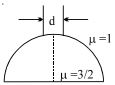
$A$ beam of diameter $‘d’$ is incident on a glass hemisphere as shown. If the radius of curvature of the hemisphere is very large in comparison to $d$, then the diameter of the beam at the base of the hemisphere will be: