Question
A body cools from 80 °C to 50 °C in 5 minutes. Calculate the time it takes to cool from 60°C to 30 °C. The temprature of the surroundings is 20°C.

Answer

According to Newton's law of cooling, we have
$\text{mc}\frac{(\text{T}_1-\text{T}_2)}{\text{t}}=\text{K}\big[\frac{(\text{T}_1+\text{T}_2)}{2}-\text{T}_0\big]\ ...(1)$
$\frac{\text{mc}}{\text{K}}=\frac{\big[\frac{\text{T}_1+\text{T}_2)}{2}-\text{T}_0\big]}{\big[\frac{(\text{T}_1-\text{T}_2)}{\text{t}}\big]}$
$\frac{\text{mc}}{\text{K}}=\frac{\big[\frac{(80+50)}{2}-20\big]}{\big[\frac{(80-50)}{5}\big]}=\frac{45}{6}$
Substituting T1 = 60 and T2 = 30 and T0 = 20 (all in °C) in Eq. (1), we get
$\text{mc}\frac{(60-30)}{\text{t}}=\text{K}\Big[\frac{(60-30)}{2}-20\Big]$
$\frac{30\text{mc}}{\text{t}}=25\text{K}$
$\text{t}=\frac{30\text{mc}}{(25\text{K})}$
$=\big(\frac{30}{25}\big)\times\big(\frac{45}{6}\big)$
= 9min
The body takes 9 min to cool from 60°C to 30°C.

Need a full question paper?

Generate a complete, print-ready paper with questions like this in minutes — across 16+ boards, with answer keys.
Start Generating Free

Similar questions

Suppose the smaller pulley of the previous problem has its radius $5.0cm$ and moment of inertia $0.10kg-m^2$. Find the tension in the part of the string joining the pulleys.
Assuming the earth to be a sphere of uniform mass density, how much would a body weigh half way down to the centre of the earth if it weighed 250N on the surface?
A steel rod $\left(Y=2.0 \times 10^{11} \mathrm{~N} \mathrm{~m}^{-2}\right.$, and $\left.\alpha=10^{-50} \mathrm{C}^{-1}\right)$ of length 1 m and area of cross-section 1 cm 2 is heated from $0^{\circ} \mathrm{C}$ to $200^{\circ} \mathrm{C}$, without being allowed to extend or bend. What is the tension produced in the rod?
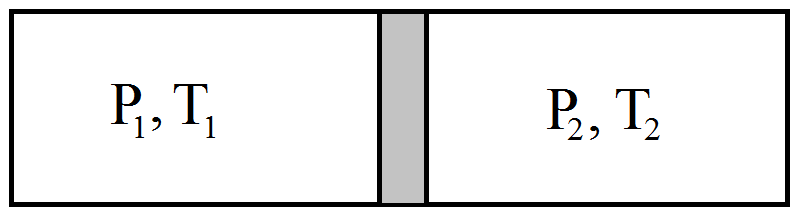
The figure shows an adiabatic cylindrical tube of volume $V_0$ divided in two parts by a frictionless adiabatic separator. Initially, the separator is kept in the middle, an ideal gas at pressure $p_1$ and temperature $T_1$ is injected into the left part and another ideal gas at pressure $p_2$ and temperature $T_2$ is injected into the right part. $\frac{\text{C}_\text{P}}{\text{C}_\text{V}}=\gamma$ is the same for both the gases. The separator is slid slowly and is released at a position where it can stay in equilibrium. Find,
  1. The volumes of the two parts.
  2. The heat given to the gas in the left part.
  3. The final common pressure of the gases.
Explain the mathematical analysis of progressive wave.
Write a labelled diagram of resonance tube and explain it. With its help establish formulas to determine the velocity of sound.
OR
Make a labelled diagram of resonance tube and describe its structure and establish the formula to find the velocity of sound at room temperature.
Two blocks of masses $400g$ and $200g$ are connected through a light string going over a pulley which is free to rotate about its axis. The pulley has a moment of inertia $1.6 \times 10^{-4}kg-m^2$ and a radius 2.0cm. Find:
  1. The kinetic energy of the system as the $400g$ block falls through $50cm$.
  2. The speed of the blocks at this instant.
A plane is in level flight at constant speed and each of its two wings has an area of $25m^2$. If the speed of the air is $180km/ h$ over the lower wing and $234km/ h$ over the upper wing surface, determine the plane’s mass. (Take air density to be 1kg $m^{–3}$).
Two blocks of masses $400g$ and $200g$ are connected through a light string going over a pulley which is free to rotate about its axis. The pulley has a moment of inertia $1.6 \times 10^{-4}kg-m^2$ and a radius $2.0cm$. Find:
  1. The kinetic energy of the system as the $400g$ block falls through $50cm$.
  2. The speed of the blocks at this instant.
A $10g$ bullet with a charge of $4.00\mu\text{C}$ is fired at a speed of $270m/s^{-1}$ in a horizontal direction. A vertical magnetic field of $500\mu\text{T}$ exists in the space. Find the deflection of the bullet due to the magnetic field as it travels through 100m. Make appropriate approximations.