Two blocks of masses $400g$ and $200g$ are connected through a light string going over a pulley which is free to rotate about its axis. The pulley has a moment of inertia $1.6 \times 10^{-4}kg-m^2$ and a radius 2.0cm. Find:
- The kinetic energy of the system as the $400g$ block falls through $50cm$.
- The speed of the blocks at this instant.
Download our app for free and get started
- Total kinetic energy of the system
- According to the question
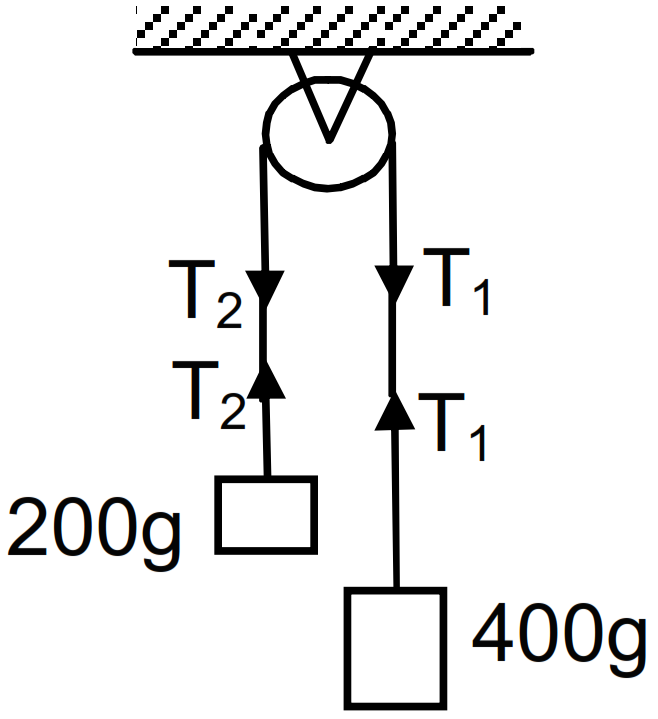
$0.4\text{g}-\text{T}_1=0.4\text{a}\ \dots(1)$
$\text{T}_2-0.2\text{g}=0.2\text{a}\ \dots(2)$
$(\text{T}_1-\text{T}_2)\text{r}=\frac{\text{la}}{\text{r}}\ \dots(3)$
From equation 1, 2 and 3
$\Rightarrow\text{a}=\frac{(0.4-0.2)\text{g}}{\big(0.4+0.2+\frac{1.6}{0.4}\big)}=\frac{\text{g}}5{}$
Therefore,
$\text{V}=\sqrt{2\text{ah}}=\sqrt{(2\times\text{gl}^5\times0.5)}$
$\Rightarrow\sqrt{\Big(\frac{\text{g}}5{}\Big)}=\sqrt{\Big(\frac{\text{9.8}}5{}\Big)}=1.4\text{m/s}.$
$\frac{1}{2}\text{m}_1\text{V}^2+\frac{1}{2}\text{m}_2\text{V}^2+\frac{1}{2}18^2$
$=\Big(\frac{1}{2}\times0.4\times1.4^2\Big)+\Big(\frac{1}{2}\times0.2\times1.4^2\Big)\\+\Big(\frac{1}{2}\times\Big(\frac{1.6}{4}\Big)\times1.4^2\Big)$
$=0.98\ \text{Joule.}$

Download our appand get started for free
Experience the future of education. Simply download our apps or reach out to us for more information. Let's shape the future of learning together!No signup needed.*
Similar Questions
- 1View SolutionA metre stick is balanced on a knife edge at its centre. When two coins, each of mass 5g are put one on top of the other at the 12.0cm mark, the stick is found to be balanced at 45.0cm. What is the mass of the metre stick?
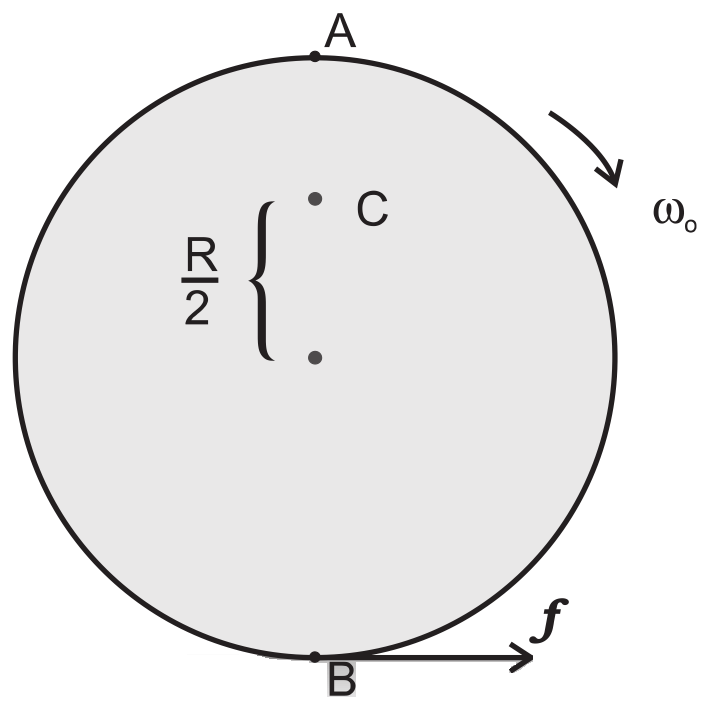
- 2A disc rotating about its axis with angular speed $\omega_0$ is placed lightly (without any translational push) on a perfectly frictionless table. The radius of the disc is R. What are the linear velocities of the points A, B and C on the disc shown in will the disc roll in the direction indicated?View Solution
- 3View SolutionTwo particles, each of mass m and speed v, travel in opposite directions along parallel lines separated by a distance d. Show that the angular momentum vector of the two particle system is the same whatever be the point about which the angular momentum is taken.
- 4A uniform cube of mass m and side a is placed on a frictionless horizontal surface. A vertical force F is applied to the edge as shown in match the following (most appropriate choice):View Solution
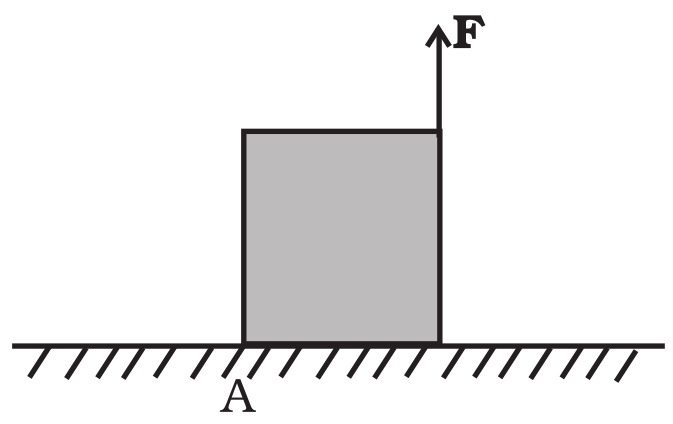
a. $\frac{\text{mg}}{4}<\text{F}<\frac{\text{mg}}{2}$ i. Cube will move up. b. $\text{F}>\frac{\text{mg}}{2}$ ii. Cube will not exhibit motion. c. $\text{F}>\text{mg}$ iii. Cube will begin to rotate and slip at A. d. $\text{F}=\frac{\text{mg}}{4}$ iv. Normal reaction effectively at $\frac{\text{a}}{3}$ - 5View SolutionDefine radius of gyration and give the physical significance of moment of inertia.
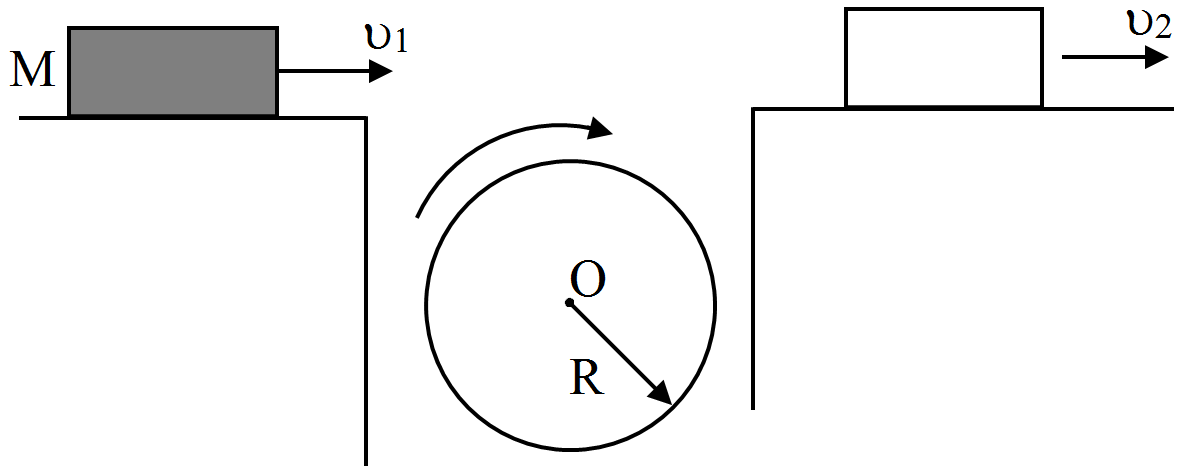
- 6A block of mass M is moving with a velocity $v_1$ on a frictionless surface as shown in fig. It passes over to a cylinder of radius R and moment of inertia I which has fixed axis and is initially at rest. When it first makes contact with the cylinder, it slips on the cylinder, but the friction is large enough so that slipping ceases before it losses contact with the cylinder. Finally it goes to the dotted position with velocity $v_2$ compute $v_2$ in terms of $v_1, M, I$ and $R$.View Solution
- 7View SolutionA particle of mass m is projected from origin O with speed u at an angle with positive x-axis. Find the angular momentum of particle at any time t about O before the particle strikes the ground again.
- 8A $2kg$ body and a $3kg$ body are moving along the x-axis. At a particular instant, the $2kg$ body is $1m$ from the origin and has a velocity of $3ms^{-1}$ and the $3kg$ body is $2m$ from the origin and has velocity of $-1 ms^{-1}$. Find the position and velocity of the centre of mass and also find the total momentum.View Solution
- 9A hollow sphere is released from the top of an inclined plane of inclination $\theta.$View Solution
- What should be the minimum coefficient of friction between the sphere and the plane to prevent sliding?
- Find the kinetic energy of the ball as it moves down a length 1 on the incline if the friction coefficient is half the value calculated in part (a).
- 10Find the centre of mass of a uniform $L-$shaped lamina $($a thin flat plate$)$ with dimensions as shown. The mass of the lamina is $3 \ kg.$View Solution