A body is just floating on the surface of a liquid. The density of the body is same as that of the liquid. The body is slightly pushed down. What will happen to the body
AIIMS 1980, Easy


Download our appand get started for free
Experience the future of education. Simply download our apps or reach out to us for more information. Let's shape the future of learning together!No signup needed.*
Similar Questions
- 1Apiece of steel has a weight $W$ in air, $W_1$ when completely immersed in water and $W_2$ when completely immersed in an unknown liquid. The relative density (specific gravity)of liquid isView Solution
- 2View SolutionThe property of a liquid by which it opposes the flow of itself is called ..........
- 3View SolutionWhich of the following is not the characteristic of turbulent flow
- 4A large open tank has two holes in the wall. One is a square hole of side $L$ at a depth $y $ from the top and the other is a circular hole of radius $ R$ at a depth $ 4y $ from the top. When the tank is completely filled with water the quantities of water flowing out per second from both the holes are the same. Then $ R$ is equal toView Solution
- 5View SolutionIf there were no gravity. which of the following will not be there for a fluid?
- 6A metallic body of material with density of $8000\ kg/m^3$ has a cavity inside. A spring balance shows its mass to be $10.0\ kg$ in air and $7.5\ kg$ when immersed in water. The ratio of the volume of the cavity to the volume of the material of the body must beView Solution
- 7Mumbai needs $1.4 \times 10^{12} L$ of water annually. Its effective surface area is $600 \,km ^2$ and it receives an average rainfall of $2.4 \,m$ annually. If $10 \%$ of this rain water is conserved, it will meet approximatelyView Solution
- 8There is a $1$ $mm $ thick layer of glycerine between a flat plate of area $100$ $cm^2$ $\&$ a big fixed plate. If the coefficient of viscosity of glycerine is $1.0$ $kg/m^{-s}$ then ....... $N$ force is required to move the plate with a velocity of $7$ $cm/s$ ?View Solution
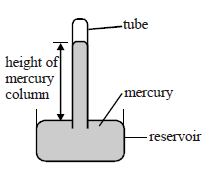
- 9View SolutionThe diagram shows a simple mercury barometer.Which of the following does not cause the height of the mercury column to vary ?
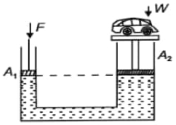
- 10In a hydraulic jack as shown, mass of the car $W=800 \,kg , A_1=10 \,cm ^2, A_2=10 \,m ^2$. The minimum force $F$ required to lift the car is $........... N$View Solution