A large open tank has two holes in the wall. One is a square hole of side $L$ at a depth $y $ from the top and the other is a circular hole of radius $ R$ at a depth $ 4y $ from the top. When the tank is completely filled with water the quantities of water flowing out per second from both the holes are the same. Then $ R$ is equal to
IIT 2000,AIEEE 2012, Diffcult


Download our appand get started for free
Experience the future of education. Simply download our apps or reach out to us for more information. Let's shape the future of learning together!No signup needed.*
Similar Questions
- 1If water is flowing in a pipe with speed $2 \,m / s$ then its kinetic energy per unit volume is ........... $J ^2 m ^3$View Solution
- 2View SolutionThe term 'fluid' is used for ............
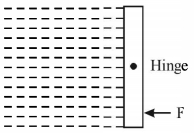
- 3A square gate of size $1\,m \times 1\,m$ is hinged at its mid-point. A fluid of density $\rho$ fills the space to the left of the gate. The force F required to hold the gate stationary isView Solution
- 4Two identical cylindrical vessels are kept on the ground and each contain the same liquid of density $d.$ The area of the base of both vessels is $S$ but the height of liquid in one vessel is $x_{1}$ and in the other, $x_{2}$. When both cylinders are connected through a pipe of negligible volume very close to the bottom, the liquid flows from one vessel to the other until it comes to equilibrium at a new height. The change in energy of the system in the process isView Solution
- 5View SolutionTo get the maximum flight, a ball must be thrown as
- 6A spherical ball of density $\rho$ and radius $0.003$ $m$ is dropped into a tube containing a viscous fluid filled up to the $0$ $ cm$ mark as shown in the figure. Viscosity of the fluid $=$ $1.260$ $N.m^{-2}$ and its density $\rho_L=\rho/2$ $=$ $1260$ $kg.m^{-3}$. Assume the ball reaches a terminal speed by the $10$ $cm$ mark. The time taken by the ball to traverse the distance between the $10$ $cm$ and $20$ $cm$ mark isView Solution
( $g$ $ =$ acceleration due to gravity $= 10$ $ ms^{^{-2}} )$

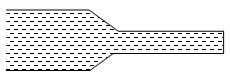
- 7Water flows through a frictionless duct with a cross-section varying as shown in fig. Pressure $p$ at points along the axis is represented byView Solution
- 8A train with cross-sectional area $S _{ t }$ is moving with speed $v_t$ inside a long tunnel of cross-sectional area $S _0\left( S _0=4 S _{ t }\right)$. Assume that almost all the air (density $\rho$ ) in front of the train flows back between its sides and the walls of the tunnel. Also, the air flow with respect to the train is steady and laminar. Take the ambient pressure and that inside the train to be $p _0$. If the pressure in the region between the sides of the train and the tunnel walls is $p$, then $p _0- p =\frac{7}{2 N } \rho v_{ t }^2$. The value of $N$ is. . . . .View Solution
- 9Two tubes of radii $r_1$ and $r_2$, and lengths $l_1$ and $l_2$, respectively, are connected in series and a liquid flows through each of them in streamline conditions. $P_1$ and $P_2$ are pressure differences across the two tubes. If $P_2$ is $4P_1$ and $l_2$ is $ \frac{l_1}{4}$ , then the radius $r_2$ will be equal toView Solution
- 10A wooden block floating in a bucket of water has $\frac{4}{5}$ of its volume submerged. When certain amount of an oil is poured into the bucket, it is found that the block is just under the oil surface with half of its volume under water and half in oil. The density of oil relative to that of water isView Solution