MCQ
A body is projected vertically upward direction from the surface of earth. If upward direction is taken as positive, then acceleration of body during its upward and downyard jourhey are respectively
  • A
    Positive, negative
  • Negative, negative
  • C
    Positive, positive
  • D
    Negative, positive

Answer

Correct option: B.
Negative, negative
b
(b)

Whether body move upwards or downwards the earth tries to pull it downwards only. Hence during both the motion $g$ will negative?

So, negative, negative

Need a full question paper?

Generate a complete, print-ready paper with questions like this in minutes — across 16+ boards, with answer keys.

Start Generating Free

Similar questions

Out of following four dimensional quantities, which one quantity is to be called a dimensional constant
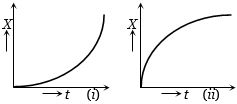
Figures $(i)$ and $(ii)$ below show the displacement-time graphs of two particles moving along the x-axis. We can say that
A gas at $NTP$ is suddenly compressed to one-fourth of its original volume. If $\gamma $ is supposed to be $\frac{3}{2}$, then the final pressure is........ atmosphere
The quantity on which the rise of liquid in capillary tube does not depend upon is
No other thermometer is as suitable as a platinum resistance thermometer to measure temperature in the entire range of
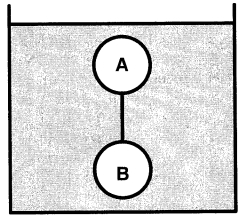
Two solid spheres $A$ and $B$ of equal volumes but of different densities $d_A$ and $d_B$ are connected by a string. They are fully immersed in a fluid of density $d_F$. They get arranged into an equilibrium state as shown in the figure with a tension in the string. The arrangement is possible only if

$(A)$ $d_Ad_F$  $(B)$ $d_B > d_F$ $(C)$ $d_A>d_F$ $(D)$ $d_A+d_B=2 d_F$

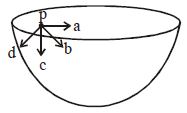
Figure shows a hemispherical shell. The direction of gravitational field intensity at point $p$ will be along
A person aiming to reach the exactly opposite point on the bank of a stream is swimming with a speed of $0.5\, m/s$ at an angle of $120^°$ with the direction of flow of water. The speed of water in the stream is..........$m/s$
The radii of two planets are respectively ${R_1}$ and ${R_2}$ and their densities are respectively ${\rho _1}$ and ${\rho _2}$. The ratio of the accelerations due to gravity at their surfaces is
This question has Statement $1$ and Statement $2$. Of the four choices given after the Statements, choose the one that best describes the two Statements.

If two springs $S_1$ and $S_2$ of force constants $k_1$ and $k_2$, respectively, are stretched by the same force, it is found that more work is done on spring $S_1$ than on spring $S_2$.
STATEMENT 1 : If stretched by the same amount work
done on $S_1$, Work done on $S_1$ is more than $S_2$
STATEMENT2: $k_1 < k_2$