Question
A body is projected with a speed v at an angle $\theta$ with horizontal to have maximum range. What is the velocity at the highest point?

Answer

For maximum range $\theta=45^\circ,$ velocity at the highest point $=\text{v}\cos45^\circ=\frac{\text{v}}{\sqrt{2}}.$

Need a full question paper?

Generate a complete, print-ready paper with questions like this in minutes — across 16+ boards, with answer keys.
Start Generating Free

Similar questions

Rain is falling vertically. A man running on the road keeps his umbrella tilted but a man standing on the street keeps his umbrella vertical to protect himself from the rain. But both of them keep their umbrella vertical to avoid the vertical sun-rays. Explain.
What is meant by 'point object' in physics?
Calculate the r.m.s velocity of oxygen molecule at 27°C. Given that atomic weight of oxygen is 16.
Because of the friction between the water in oceans with the earth's surface, the rotational kinetic energy of the earth is continuously decreasing. If the earth's angular speed decreases by 0.0016rad/ day in 100 years, find the average torque of the friction on the earth. Radius of the earth is 6400km and its mass is $6.0 \times 10^{24}kg$.
The fundamental frequency of a closed pipe is 293Hz when the air in it is at a temperature of 20°C. What will be its fundamental frequency when the temperature changes to 22°C?
$50 \mathrm{~m}^3$ of saturated vapour is cooled down from $30^{\circ} \mathrm{C}$ to $20^{\circ} \mathrm{C}$. Find the mass of the water condensed. The absolute humidity of saturated water vapour is $30 \mathrm{gm}^{-3}$ at $30^{\circ} \mathrm{C}$ and $16 \mathrm{gm}^{-3}$ at $20^{\circ} \mathrm{C}$.
On a hot summer day we want to cool our room by opening the refrigerator door and closing all the windows and doors. Will the process work ?
If the resultant torque of all the forces acting on a body is zero about a point, is it necessary that it will be zero about any other point?
The gravitational field in a region is given by $\overrightarrow{\text{E}}=(5\text{N/kg})\overrightarrow{\text{i}}+(12\text{N/kg})\overrightarrow{\text{j}}.$
  1. Find the magnitude of the gravitational force acting on a particle of mass $2\ kg$ placed at the origin.
  2. Find the potential at the points $(12m, 0)$ and $(0, 5m)$ if the potential at the origin is taken to be zero.
  3. Find the change in gravitational potential energy if a particle of mass $2\ kg$ is taken from the origin to the point $(12m, 5m)$.
  4. Find the change in potential energy if the particle is taken from $(12m, 0)$ to $(0, 5m)$.
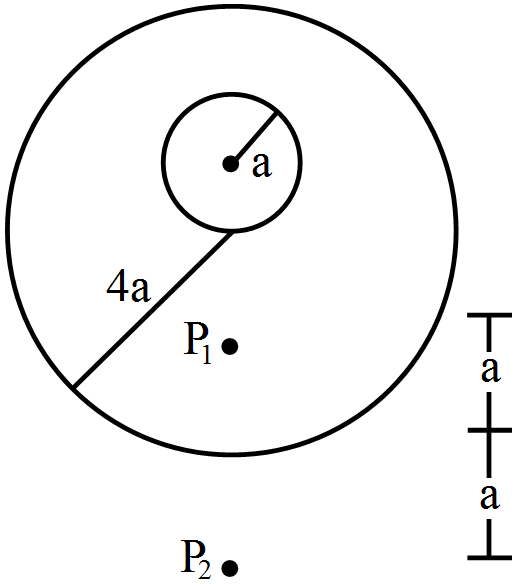
A uniform metal sphere of radius a and mass M is surrounded by a thin uniform spherical shell of equal mass and radius 4a The centre of the shell falls on the surface of the inner sphere. Find the gravitational field at the points $P_1$ and $P_2$ shown in the figure.