A body of $5\, kg$ weight kept on a rough inclined plane of angle $30^o$ starts sliding with a constant velocity. Then the coefficient of friction is
Easy
Download our app for free and get started
(a)$\mu = \tan 30^\circ = \frac{1}{{\sqrt 3 }}$.

Download our appand get started for free
Experience the future of education. Simply download our apps or reach out to us for more information. Let's shape the future of learning together!No signup needed.*
Similar Questions
- 1One end of string of length $l$ is connected to a particle of mass $'m'$ and the other end is connected to a small peg on a smooth horizontal table. If the particle moves in circle with speed $'v',$ the net force on the particle (directed towards centre) will be ($T$ represents the tension in the string)View Solution
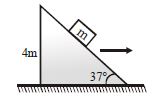
- 2If the coefficient of friction between block & wedge is $\mu $, then the maximum horizontal acceleration of the wedge for which block will remain at rest w.r.t. the wedge isView Solution
- 3Two bodies of equal masses revolve in circular orbits of radii ${R_1}$ and ${R_2}$ with the same period. Their centripetal forces are in the ratioView Solution
- 4A car is moving on a circular path and takes a turn. If ${R_1}$ and ${R_2}$ be the reactions on the inner and outer wheels respectively, thenView Solution
- 5A block of mass $m$ is placed on a surface with a vertical coss section given by $y = \frac{{{x^3}}}{6}$ . If the coefficient of friction is $0.5$, the maximum height above the ground at which the block can be placed without slipping isView Solution
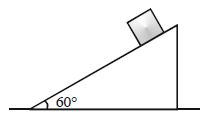
- 6A block slides down an inclined plane with an acceleration $g/2$ as shown in fig. Then coefficient of kinetic friction isView Solution
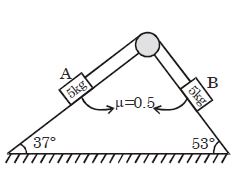
- 7In the shown arrangement if $f_A\,,\, f_B$ and $T$ be the frictional forces on $A$ Block, $B$ Block and tension in the string respectively, then their values areView Solution
- 8A particle moves in a horizontal circle on the smooth inner surface of a hemispherical bowl of radius $R$. The plane of motion is at a depth $d$ below the centre of the hemisphere. The speed of the particle is :-View Solution
- 9A block of mass $M$ slides down on a rough inclined plane with constant velocity. The angle made by the incline plane with horizontal is $\theta$. The magnitude of the contact force will be.View Solution
- 10A body is sliding down an inclined plane (angle of inclination $45^o$). If the coefficient of friction is $0.5$ and $g = 9.8\, m/s^2$. then the acceleration of the body downwards in $m/s^2$ isView Solution