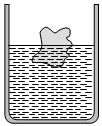
A body of density $\rho'$ is dropped from rest at a height $h$ into a lake of density $\rho$ , where $\rho > \rho '$ . Neglecting all dissipative forces, calculate the maximum depth to which the body sinks before returning to float on the surface.
Diffcult


Download our appand get started for free
Experience the future of education. Simply download our apps or reach out to us for more information. Let's shape the future of learning together!No signup needed.*
Similar Questions
- 1View SolutionWhen an air bubble rises from the bottom of a deep lake to a point just below the water surface, the pressure of air inside the bubble
- 2A liquid having coefficient of viscosity $0.02$ decapoise is filled in a container of cross-sectional area $20 \,m ^2$. If viscous drag between two adjacent layers in flowing is $1 \,N$, then velocity gradient is ........ $s ^{-1}$View Solution
- 3The vertical limbs of a $U$ shaped tube are filled with a liquid of density $\rho$ upto a height $h$ on each side. The horizontal portion of the $U$ tube having length $2h$ contains a liquid of density $2\rho$ . The $U$ tube is moved horizontally with an accelerator $g/2$ parallel to the horizontal arm. The difference in heights in liquid levels in the two vertical limbs, at steady state will beView Solution
- 4The terminal velocity $\left( v _{ t }\right)$ of the spherical rain drop depends on the radius ( $r$ ) of the spherical rain drop asView Solution
- 5A pressure-pump has a horizontal tube of cross-sectional area $10\,cm ^{2}$ for the outflow of water at a speed of $20\,m / s$. The force exerted on the vertical wall just in front of the tube which stops water horizontally flowing out of the tube, is $...N$ [given : density of water $=1000\,kg / m ^{3}$ ]View Solution
- 6A hosepipe directs a horizontal jet of water moving with velocity of $20\, m/s$ on a vertical wall. The cross-sectional area of jet is $10^{-3}\,m^2$. If density of water is $1000\, kg/m^3$, then force acting on wall is ........... $N$ [Assuming water comes to rest after striking wall]View Solution
- 7A hemispherical bowl just floats without sinking in a liquid of density $1.2 × 10^3kg/m^3$. If outer diameter and the density of the bowl are $1 m$ and $2 × 10^4 kg/m^3$ respectively, then the inner diameter of the bowl will be........ $m$View Solution
- 8View SolutionIf there were no gravity. which of the following will not be there for a fluid?
- 9A solid sphere, of radius $R$ acquires a terminal velocity $\nu_1 $ when falling (due to gravity) through a viscous fluid having a coefficient of viscosity $\eta $. The sphere is broken into $27$ identical solid spheres. If each of these spheres acquires a terminal velocity, $\nu_2$, when falling through the same fluid, the ratio $(\nu_1/\nu_2)$ equalsView Solution
- 10View SolutionA body floats in a liquid contained in a beaker. If the whole system as shown in figure falls freely under gravity, then the upthrust on the body due to liquid is