A solid sphere, of radius $R$ acquires a terminal velocity $\nu_1 $ when falling (due to gravity) through a viscous fluid having a coefficient of viscosity $\eta $. The sphere is broken into $27$ identical solid spheres. If each of these spheres acquires a terminal velocity, $\nu_2$, when falling through the same fluid, the ratio $(\nu_1/\nu_2)$ equals
JEE MAIN 2019, Diffcult


Download our appand get started for free
Experience the future of education. Simply download our apps or reach out to us for more information. Let's shape the future of learning together!No signup needed.*
Similar Questions
- 1Two stretched membranes of area $2\, cm^2$ and $3\, cm^2$ are placed in a liquid at the same depth. The ratio of pressures on them isView Solution
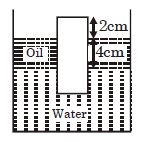
- 2A cylinder of radius $4\ cm$ and height $10\ cm$ is immersed in two liquids as shown. Specific gravity of oil is $0.5$ . $2\ cm$ of cylinder is in the air. Select the $INCORRECT$ statement. Neglect atmospheric pressure.View Solution
- 3The terminal velocity of a copper ball of radius $5\,mm$ falling through a tank of oil at room temperature is $10\,cm\,s ^{-1}$. If the viscosity of oil at room temperature is $0.9\,kg\,m ^{-1} s ^{-1}$, the viscous drag force is :View Solution
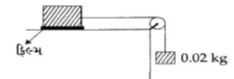
- 4A metal block of base area $0.2\; m ^{2}$ is connected to a $0.02\; kg$ mass via a string that passes over an ideal pulley as shown in figure. A liquid film of thickness $0.6\; mm$ is placed between the block and the table. When released the block moves to the right with a constant speed of $0.17\; m / s$. The co-efficient of viscosity of the liquid isView Solution
- 5A ball rises to surface at a constant velocity in a liquid whose density is $4$ times greater than that of the material of the ball. The ratio of the force of friction acting on the rising ball and its weight isView Solution
- 6An ideal fluid flows (laminar flow) through a pipe of non-uniform diameter. The maximum and minimum diameters of the pipes are $6.4 \;\mathrm{cm}$ and $4.8 \;\mathrm{cm},$ respectively. The ratio of the minimum and the maximum velocities of fluid in this pipe is:View Solution
- 7A liquid of density $10^3 \,kg / m ^3$ and coefficient of viscosity $8 \times 10^{-2} \;decapoise$ is flowing in a tube of radius $2 \,cm$ with speed $2 \,m / s$. The Reynold's number is ..........View Solution
- 8A stream-lined body falls through air from a height $h$ on the surface of liquid. Let $d$ and $D$ denote the densities of the materials of the body and the liquid respectively. If $D > d$, then the time after which the body will be instantaneously at rest, isView Solution
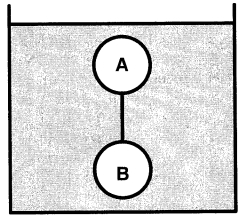
- 9Two solid spheres $A$ and $B$ of equal volumes but of different densities $d_A$ and $d_B$ are connected by a string. They are fully immersed in a fluid of density $d_F$. They get arranged into an equilibrium state as shown in the figure with a tension in the string. The arrangement is possible only ifView Solution
$(A)$ $d_Ad_F$ $(B)$ $d_B > d_F$ $(C)$ $d_A>d_F$ $(D)$ $d_A+d_B=2 d_F$
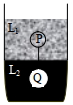
- 10Two spheres $P$ and $Q$ of equal radii have densities $\rho_1$ and $\rho_2$, respectively. The spheres are connected by a massless string and placed in liquids $L_1$ and $L_2$ of densities $\sigma_1$ and $\sigma_2$ and viscosities $\eta_1$ and $\eta_2$, respectively. They float in equilibrium with the sphere $P$ in $L_1$ and sphere $Q$ in $L _2$ and the string being taut (see figure). If sphere $P$ alone in $L _2$ has terminal velocity $\overrightarrow{ V }_{ P }$ and $Q$ alone in $L _1$ has terminal velocity $\overrightarrow{ V }_{ Q }$, thenView Solution
$(A)$ $\frac{\left|\overrightarrow{ V }_{ P }\right|}{\left|\overrightarrow{ V }_{ Q }\right|}=\frac{\eta_1}{\eta_2}$ $(B)$ $\frac{\left|\overrightarrow{ V }_{ P }\right|}{\left|\overrightarrow{ V }_{ Q }\right|}=\frac{\eta_2}{\eta_1}$
$(C)$ $\overrightarrow{ V }_{ P } \cdot \overrightarrow{ V }_{ Q } > 0$ $(D)$ $\overrightarrow{ V }_{ P } \cdot \overrightarrow{ V }_{ Q } < 0$