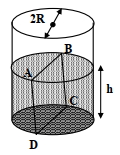
A hemispherical bowl just floats without sinking in a liquid of density $1.2 × 10^3kg/m^3$. If outer diameter and the density of the bowl are $1 m$ and $2 × 10^4 kg/m^3$ respectively, then the inner diameter of the bowl will be........ $m$
Diffcult


Download our appand get started for free
Experience the future of education. Simply download our apps or reach out to us for more information. Let's shape the future of learning together!No signup needed.*
Similar Questions
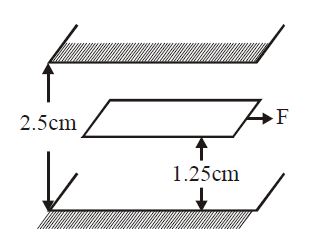
- 1A space $2.5\ cm$ wide between two large plane surfaces is filled with oil. Force required to drag very thin plate of area $0.5\ m^2$ just midway the surfaces at a speed of $0.5\ m/sec$ is $1\ N$ The coefficient of viscosity in $kg-s/m^2$ is :View Solution
- 2$Assertion :$ In a pressure cooker the water is brought to boil. The cooker is then remove from the stove. Now on removing the lid of the pressure cooker, the water starts boiling against.View Solution
$Reason :$ The impurities in water bring down its boiling point - 3A ball of relative density $0.8$ falls into water from a height of $2$ $m$. The depth to which the ball will sink is ........ $ m$ (neglect viscous forces) :View Solution
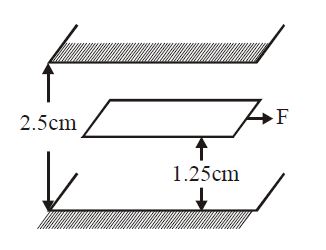
- 4A space $2.5\ cm$ wide between two large plane surfaces is filled with oil. Force required to drag very thin plate of area $0.5\ m^2$ just midway the surfaces at a speed of $0.5\ m/sec$ is $1\ N$ The coefficient of viscosity in $kg-s/m^2$ is :View Solution
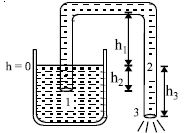
- 5Figure shows a siphon. Choose the wrong statement:View Solution
($P_0$ = atmospheric pressure)
- 6The reading of pressure metre attached with a closed pipe is $4.5 \times 10^4 \mathrm{~N} / \mathrm{m}^2$. On opening the valve, water starts flowing and the reading of pressure metre falls to $2.0 \times 10^4 \mathrm{~N} / \mathrm{m}^2$. The velocity of water is found to be $\sqrt{\mathrm{V}} \mathrm{m} / \mathrm{s}$. The value of $\mathrm{V}$ is__________View Solution
- 7Two cyllinders of same cross-section and length $L$ but made of two material of densities $d_1$ and $d_2$ are cemented together to form a cylinder of length $2L$. The combination floats in a liquid of density $d$ with $a$ length $L/2$ above the surface of the liquid. If $d_1 > d_2$ then:View Solution
- 8The terminal velocity $\left( v _{ t }\right)$ of the spherical rain drop depends on the radius ( $r$ ) of the spherical rain drop asView Solution
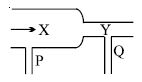
- 9A steady flow of water passes along a horizontal tube from a wide section $X$ to the narrower section $Y$, see figure. Manometers are placed at $P$ and $Q$ at the sections. Which of the statements $A, B, C, D, E$ is most correct?View Solution
- 10Water is filled up to a height $h$ in a beaker of radius $R$ as shown in the figure. The density of water is $\rho$, the surface tension of water is $T$ and the atmospheric pressure is $P_0$. Consider a vertical section $A B C D$ of the water column through a diameter of the beaker. The force on water on one side of this section by water on the other side of this section has magnitudeView Solution