MCQ
A body of mass $(5 \pm 0.5) kg$ is moving with a velocity of $(20 \pm 0.4) m / s$. Its kinetic energy will be
- ✓$(1000 \pm 140)\,J$
- B$(1000 \pm 0.14)\,J$
- C$(500 \pm 0.14)\,J$
- D$(500 \pm 140)\,J$
$k =\frac{1}{2} \times 5 \times 400=5 \times 200=1000\,J$
$\frac{\Delta k }{2 k }=\frac{\Delta m }{ m }+\frac{2 \Delta v }{ v }=\frac{0.5}{5}+\frac{2 \times 0.4}{20}$
$\Delta k =1000\left(\frac{1}{10}+\frac{4}{100}\right)=1000\left(\frac{10+4}{100}\right)=140\,J$
Generate a complete, print-ready paper with questions like this in minutes — across 16+ boards, with answer keys.
Which one of the following options is correct?
$($Take : specific heat of water$ = 4200\,J\,k{g^{ - 1}}\,{K^{ - 1}}$, latent heat of ice $ = 336\,kJ\,k{g^{ - 1}})$
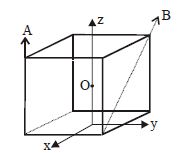
$(a)$ The moment of inertia of cube about $z-$ axis is $I_z$ = $I_x + I_y$
$(b)$ The moment of inertia of cube about $A-$ axis is $I_A$=${I_z} + \frac{{m{a^2}}}{2}$
$(c)$ The moment of inertia of cube about $B-$ axis is $I_B$=${I_z} + \frac{{m{a^2}}}{2}$
$(d)$ $I_x$ = $I_z$