MCQ
A body of mass m is attached to a spring and oscillates. If the force constant of the spring is K, then the period of oscillation of the body will be:
  • A
    $2 \pi \sqrt{\frac{K}{m}}$
  • $2 \pi \sqrt{\frac{m}{K}}$
  • C
    $\frac{1}{2 \pi} \sqrt{\frac{m}{K}}$
  • D
    $\frac{1}{2 \pi} \sqrt{\frac{K}{m}}$
Answer

Correct option: B.
$2 \pi \sqrt{\frac{m}{K}}$
(B)

Need a full question paper?

Generate a complete, print-ready paper with questions like this in minutes — across 16+ boards, with answer keys.

Start Generating Free

Similar questions

The centre of mass of an extended body on the surface of the earth and its centre of gravity.
A particle of mass $200 \,g$ is moving in a circle of radius $2 \,m$. The particle is just 'looping the loop'. The speed of the particle and the tension in the string at highest point of the circular path are $\left(g=10 \,ms ^{-2}\right)$
$A$ block of mass $M$ is placed on $a$ horizontal surface and it is tied with an inextensible string to $a$ block of mass, as shown in figure. A block of mass $m_0$ is also placed on $M$ The minimum value of $\mu$ between the block $M$ and $m_0$ (taking horizontal surface frictionless) for which all the three blocks move together, is
Water flows steadily through a horizontal pipe of variable cross-section. If the pressure of water is $P$ at a point where flow speed is $v$ , the pressure at another point where the flow speed is $2v$ , is (Take density of water as $\rho $ )
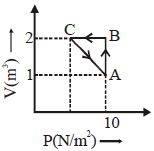
An ideal gas is taken through the cycle $A \to B \to C \to A,$ as shown in the figure. What is the change in internal energy ...... $J$.
Two gases of equal mass are in thermal equilibrium. If ${P_a},\,{P_b}$ and ${V_a}$ and ${V_b}$ are their respective pressures and volumes, then which relation is true
$Assertion :$ In isothermal process whole of the heat supplied to the body is converted into internal energy.
$Reason :$ According to the first law of thermodynamics :  $\Delta Q = \Delta U + p\Delta V$
Hooke's law is applicable for ....
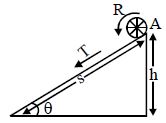
Suppose a body of mass $M$ and radius $R$ is allowed to roll on an inclined plane without slipping from its topmost point $A$. The velocity acquired by the body, as it reaches the bottom of the inclined plane, is given by $\beta  = 1 + \frac{I}{{M{R^2}}}$
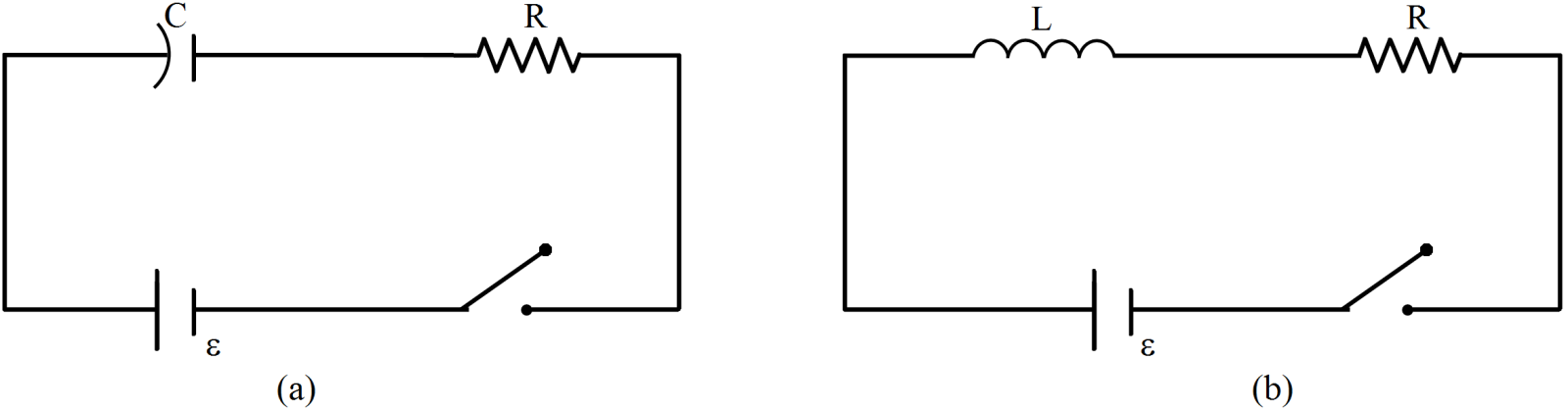
The switches in figure are closed at $t = 0$ and reopened after a long time at $t = t_0$: