A body of mass $\mathrm{m}=10\; \mathrm{kg}$ is attached to one end of a wire of length $0.3\; \mathrm{m} .$ The maximum angular speed (in $rad \;s^{-1}$ ) with which it can be rotated about its other end in space station is (Breaking stress of wire $=4.8 \times 10^{7} \;\mathrm{Nm}^{-2}$ and area of cross-section of the wire $=10^{-2}\; \mathrm{cm}^{2}$ ) is
JEE MAIN 2020, Medium


Download our appand get started for free
Experience the future of education. Simply download our apps or reach out to us for more information. Let's shape the future of learning together!No signup needed.*
Similar Questions
- 1A wire of area of cross-section $10^{-6}\,m^2$ is increased in length by $0.1\%$. The tension produced is $1000\, N$. The Young's modulus of wire isView Solution
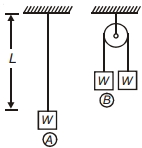
- 2If in case $A$, elongation in wire of length $L$ is $l$, then for same wire elongation in case $B$ will be ......View Solution
- 3In a wire of length $L,$ the increase in its length is $l.$ If the length is reduced to half, the increase in its length will beView Solution
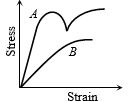
- 4The diagram shows stress v/s strain curve for the materials $A$ and $B$. From the curves we infer thatView Solution
- 5The length of a metal wire is $l_1$, when the tension in it is $T_1$ and is $l_2$ when the tension is $T_2$. The unstretched length of the wire isView Solution
- 6A cube of aluminium of sides $0.1\, m$ is subjected to a shearing force of $100\, N$. The top face of the cube is displaced through $0.02 \,cm$ with respect to the bottom face. The shearing strain would beView Solution
- 7Young's modulus of rubber is ${10^4}\,N/{m^2}$ and area of cross-section is $2\,c{m^2}$. If force of $2 \times {10^5}$ dynes is applied along its length, then its initial length $l$ becomesView Solution
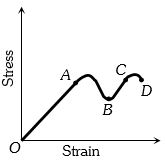
- 8In the below graph, point $B$ indicatesView Solution
- 9When a rubber ball is taken to the bottom of a sea of depth $1400 \,m$, its volume decreases by $2 \%$. The Bulk modulus of rubber ball is .................. $\times 10^8 N / m ^2$ [density of water is $1 \,g cc$ and $g=10 \,m / s ^2$ ]View Solution
- 10A wire fixed at the upper end stretches by length $l$ by applying a force $F$. The work done in stretching isView Solution