The length of a metal wire is $l_1$, when the tension in it is $T_1$ and is $l_2$ when the tension is $T_2$. The unstretched length of the wire is
Diffcult


Download our appand get started for free
Experience the future of education. Simply download our apps or reach out to us for more information. Let's shape the future of learning together!No signup needed.*
Similar Questions
- 1Given below are two statements: one is labelled as Assertion $A$ and the other is labelled as Reason $R$View Solution
Assertion $A$: Steel is used in the construction of buildings and bridges.
Reason $R:$ Steel is more elastic and its elastic limit is high.
In the light of above statements, choose the most appropriate answer from the options given below
- 2View SolutionTwo different types of rubber are found to have the stress-strain curves as shown. Then
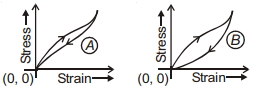
- 3The Young's modulus of a wire of length $L$ and radius $r$ is $Y$. If the length is reduced to $\frac{L}{2}$ and radius is $\frac{r}{2}$ , then the Young's modulus will beView Solution
- 4Steel and copper wires of same length are stretched by the same weight one after the other. Young's modulus of steel and copper are $2 \times {10^{11}}\,N/{m^2}$ and $1.2 \times {10^{11}}\,N/{m^2}$. The ratio of increase in lengthView Solution
- 5The area of a cross-section of steel wire is $0.1\,\,cm^2$ and Young's modulus of steel is $2\,\times \,10^{11}\,\,N\,\,m^{-2}.$ The force required to stretch by $0.1\%$ of its length is ......... $N$.View Solution
- 6The diameter of a brass rod is 4 mm and Young's modulus of brass is $9 \times {10^{10}}\,N/{m^2}$. The force required to stretch by $0.1\%$ of its length isView Solution
- 7Two wires of copper having the length in the ratio $4 : 1$ and their radii ratio as $1 : 4$ are stretched by the same force. The ratio of longitudinal strain in the two will beView Solution
- 8The specific heat at constant pressure and at constant volume for an ideal gas are ${C_p}$ and ${C_v}$ and its adiabatic and isothermal elasticities are ${E_\varphi }$ and ${E_\theta }$ respectively. The ratio of ${E_\varphi }$ to ${E_\theta }$ isView Solution
- 9When a force is applied on a wire of uniform cross-sectional area $3 \times {10^{ - 6}}\,{m^2}$ and length $4m$, the increase in length is $1\, mm.$ Energy stored in it will be $(Y = 2 \times {10^{11}}\,N/{m^2})$View Solution
- 10View SolutionDue to addition of impurities, the modulus of elasticity