Question
A body rotates about a fixed axis with an angular acceleration of $3 \,rad / s ^2$. The angle rotated by it during the time when its angular velocity increases from $10 \,rad / s$ to $20 \,rad / s$ (in radian) is ..........
Given $\alpha = 3$
$w_2^2=w_1^2+2 \alpha \theta$
$\Rightarrow (20)^2=(10)^2+2 \times 3 \theta$
$\Rightarrow \frac{300}{6}=\theta$
$\Rightarrow \theta=50 \text { radian. }$
Generate a complete, print-ready paper with questions like this in minutes — across 16+ boards, with answer keys.
If the origin of the coordinate system is taken to be at the centre of the lens, the coordinates (in $\mathrm{cm}$ ) of the point $(x, y)$ at which the image is formed are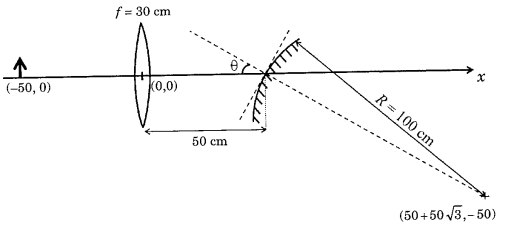
|
List $- I$ (Products formed) |
List $- II$ (Reaction of carbonyl compound with) |
| $(a)$ Cyanohydrin | $(i)$ $NH _{2} OH$ |
| $(b)$ Acetal | $(ii)$ $RNH _{2}$ |
| $(c)$ Schiff's base | $(iii)$ alcohol |
| $(d)$ Oxime | $(iv)$ $HCN$ |
Choose the correct answer from the options given below: