MCQ
A body rotating with uniform angular acceleration covers $100 \pi$ (radian) in the first $5 \,s$ after the start. Its angular speed at the end of $5 \,s$ (in radian/s) is .........$\pi$
  • $40$
  • B
    $30$
  • C
    $20$
  • D
    $10$

Answer

Correct option: A.
$40$
a
(a)

Given, $\theta=100 \,\pi$ radians

$t=5\,s$

From the second equation of angular motion, $\theta=\frac{1}{2} at ^2$

$=100\,\pi=\frac{1}{2} \alpha \times 5^2$

$=8\,\pi rad / s ^2$

$\therefore \omega= at =8\,\pi \times 5=40\,\pi \text { radians }$

Need a full question paper?

Generate a complete, print-ready paper with questions like this in minutes — across 16+ boards, with answer keys.
Start Generating Free

Similar questions

The back $e.m.f$. induced in a coil, when current changes from $1$ ampere to zero in one milli second, is $4$ volts, the self inductance of the coil is
The rate of flow of liquid in a tube of radius $r,$  length $ l,$  whose ends are maintained at a pressure difference $P$  is $V = \frac{{\pi QP\,{r^4}}}{{\eta l}}$ where $\eta $ is coefficient of the viscosity and $Q$ is
Microscope is an optical instrument which
One end of a uniform wire of length $L$ and of weight $W$ is attached rigidly to a point in the roof and a weight ${W_1}$ is suspended from its lower end. If $S$ is the area of cross-section of the wire, the stress in the wire at a height $3L/4$ from its lower end is
The radioactive nucleus $_7{N^{13}}$decays to $_6{C^{13}}$ through the emission of
Two sphere of radius $R_1$ and $R_2$ have densities ${\rho _1}$ and  ${\rho _2}$ and specific heat $S_1$ and $S_2$ if they are heated to the same temperature the ratio of their rates of falling temperature will be
 A nucleus  $_n{X^m}$ emits one $\alpha$ particle and two $\beta$ particles. The resulting nucleus is
The temperature of the mixture of one mole of helium and one mole of hydrogen is increased from ${0^o}C$ to ${100^o}C$ at constant pressure. The amount of heat delivered will be ...... $cal$
Moment of inertia of a disc about its own axis is $I$.  Its moment of inertia about a tangential axis in its plane is
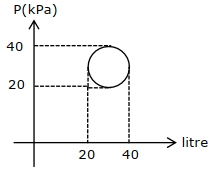
In the reported figure, heat energy absorbed by a system in going through a cyclic process is $......\,\pi J$